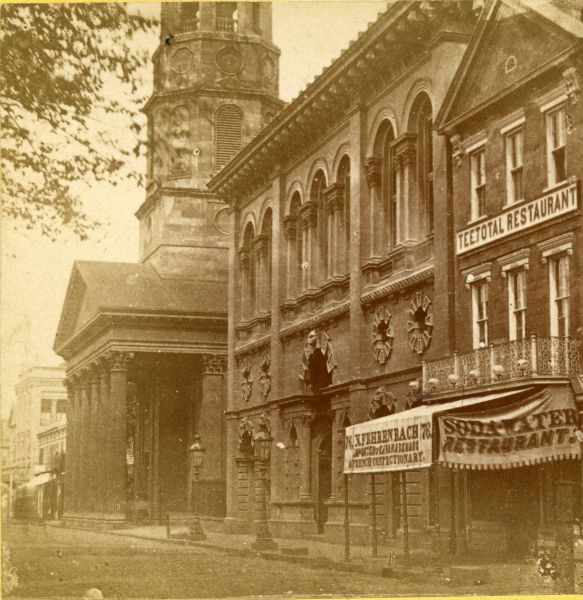
Secession Hall in Charleston, South Carolina. Credit: The Civil War Trust.
In the wake of the disconcerting result of the Election of 1860, the nature of southern secessionism suggested the imminent secession of at least some southern states from the Union. The timing and execution of states actually seceding from the Union was unclear, but the Deep South was prepared to act first. (more…)
Abraham Lincoln’s victory in the Election of 1860 was disconcerting news for the South. It was the most recent event in a string of events that seemingly endangered the southern way of life and the future of the country. At a time when many northerners suspected southern threats of secession were but a bluff, there was evidence that the country had already split and the formalities were soon to follow. (more…)
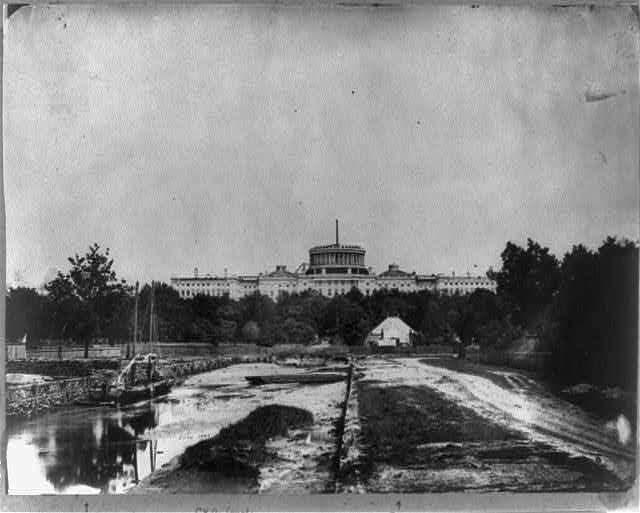
The United States Capitol in 1860. Courtesy: Library of Congress
Every presidential election is consequential, but the Election of 1860 would play a significant role in whether the United States would remain one nation. The division of the North and South on the issue of slavery threatened to cause a secession of the South. The result of the election would determine whether that threat would materialize and cause a Second American Revolution. (more…)
Construction on the Capitol in 1859. Courtesy: William England, Getty Images.
By 1859, the northern and southern sections of America had developed different economic systems, cultural norms, and approaches to permitting slavery. Congress and the political parties had been able to overlook those differences for the sake of self-preservation and advancement of the collective agenda. As 1859 concluded and 1860 sprang, Americans understood that the status quo of compromise was not to continue much longer. (more…)
For the bulk of the early 19th Century, slaveholders in the South had a deep fear that a slave revolt would erupt and metastasize, leading to an eradication of the institution, similar to what happened in Haiti in the first years of the 19th Century. In 1859, John Brown, one of the instigators in Bleeding Kansas, would attempt to lead such a revolt, starting at a federal armory in Harpers Ferry, Virginia. The immediate effects of his raid would pale in comparison to its impact over the course of the following two years. (more…)
Following the Compromise of 1850, southerners became concerned about the North securing additional concessions from the South. Aware of the South’s concerns, President Millard Fillmore tried to calm southern nerves by (more…)
John Calhoun and his like-minded supporters hoped that nullification would become a legitimate alternative to secession for the South. Nullification was the doctrine that Calhoun believed meant that states could nullify a federal law, on the basis that states had their own sovereignty and the federal government could not infringe on that sovereignty. See Daniel Walker Howe, What Hath God Wrought: Transformation of America, 1815-1848, 402. This approach was designed to primarily perpetuate the institution of slavery, without the conflict culminating in secession, or worse, civil war.



 Last Best Hope of Earth