Tag: States’ Rights

  • The Civil War: George Templeton Strong: Diary, November 20-December 1, 1860

    The Civil War: George Templeton Strong: Diary, November 20-December 1, 1860

    November 20, 1860 to December 1, 1860

    New York City

    State laws often have an outsized influence on discussions of national politics. This is despite the fact that one state’s laws have no binding effect in other states; then, add to that the fact that some states will pass laws with little intent or resources backing the enforcement of those laws. Those are the laws that can be nothing more than pieces of paper as props in the political theater. But, when those laws touch on an inflammatory issue, the practicalities of the laws become irrelevant. The only thing that matters then is that the laws exist and that they could spread to other states, disrupting the status quo and creating concern as to the path that the nation and its states have chosen.

    (more…)
  • Constitution Sunday: “Publius,” The Federalist XLVI [James Madison]

    New-York Packet

    January 29, 1788

    James Madison, who would later become the fourth President of the United States, sought to quell fears of an overreaching and overly powerful federal government. The Constitution’s opponents had shared their fears—fears that Madison called “chimerical”—of a federal government that took power from the states and dominated the country’s governing. Rather than the states governing themselves and the federal government keeping to its own affairs, many of which related to international relations, the thinking was that the federal government would subsume those states’ powers and undermine their sovereignty.

    (more…)
  • Constitution Sunday: “Publius,” The Federalist XLIV [James Madison] Part I

    New-York Packet

    January 25, 1788

    In a country comprised of states, there is bound to be overlap between what those states’ governments may do and what the federal government may do. But the draft Constitution clarified those boundaries and identified many of the rights that states have and don’t have. Crucially, the Constitution sets limits for what states may do to hinder their economies and to prosecute criminal behavior.

    (more…)
  • Constitution Sunday: On The Likely Failure Of Liberty, Robert Yates and John Lansing, Jr., to Governor George Clinton

    Constitution Sunday: On The Likely Failure Of Liberty, Robert Yates and John Lansing, Jr., to Governor George Clinton

    January 14, 1788

    Daily Advertiser (New York)

    Revising the Articles of Confederation was always going to be a difficult task. The system that the Articles erected was one where the states pulled the strings of a marionette puppet of a federal government; without the states, the federal government was nothing: for instance, although the Confederation Congress could impose a tax, it lacked any independent power of enforcement and would need unanimous approval of the state legislatures. Nonetheless, when delegates met in Philadelphia in a convention that resulted in the draft Constitution, they had originally set out to revise those Articles of Confederation, and, by amendment, to refine the existing system into a more functional, more effective government.

    (more…)
  • Constitution Sunday: James Wilson’s Summation and Final Rebuttal

    Constitution Sunday: James Wilson’s Summation and Final Rebuttal

    Pennsylvania Ratifying Convention.

    December 11, 1787

    Before concluding the Pennsylvania Ratifying Convention, James Wilson delivered a closing argument for ratifying the draft Constitution and took on many of his adversaries’ best arguments while presenting the most compelling reasons for adopting the Constitution. To detractors of the Constitution, a most glaring flaw in the document was its creation of a relatively powerful federal government as compared to that existing under the Articles of Confederation. Some called for scrapping the draft Constitution and simply enlarging the powers of the present federal government to make it more effective yet still modest.

    (more…)
  • Constitution Sunday: Robert Whitehill at the Pennsylvania Convention

    Pennsylvania Ratifying Convention.

    November 30, 1787.

    At the Pennsylvania Convention, Robert Whitehill rose to speak about the proposed Constitution including—and perhaps especially—its biggest flaw. To Whitehill, despite the fact that the country’s learned people devised the Constitution, “the defect is in the system itself,—there lies the evil which. no argument can palliate, no sophistry can disguise.” The Constitution, as it was written, “must eventually annihilate the independent sovereignty of the several states” given the power that the Constitution allotted to the federal government.

    (more…)
  • The North’s Attempt at Salvation

    washington-dc
    Aerial Perspective of Washington DC in 1861.

    The Deep South’s animating of a Second American Revolution, by seceding from the Union and laying the foundation for an operational Confederate government, forced the North to either suppress the South’s uprising or craft a resolution. The likelihood of war would deter any widespread northern suppression, leaving the question: What compromise could the North propose that appeased the South and put both sections of the country on a path of coexistence? While variations of this question had been posed in the years leading up to 1860, at no prior point were states seceding from the Union en masse to form a rival government. (more…)

  • Constitution Sunday: Answers to Mason’s “Objections”: “Marcus” [James Iredell] IV

    Answers to Mason’s “Objections”: “Marcus” [James Iredell] IV

    Norfolk and Portsmouth Journal (Virginia), March 12, 1788

    Following are excerpts from James Iredell’s responses to George Mason’s “Objections” to the Constitution:

    VIIIth. Objection. ‘Under their own construction of the general clause at the end of the enumerated powers, the Congress may grant monopolies in trade and commerce, constitute new crimes, inflict unusual and severe punishments, and extend their power as far as they shall think proper (more…)

  • The Theories of Slavery

    a89cbad2a1dccb130f3199e02ae7de2c
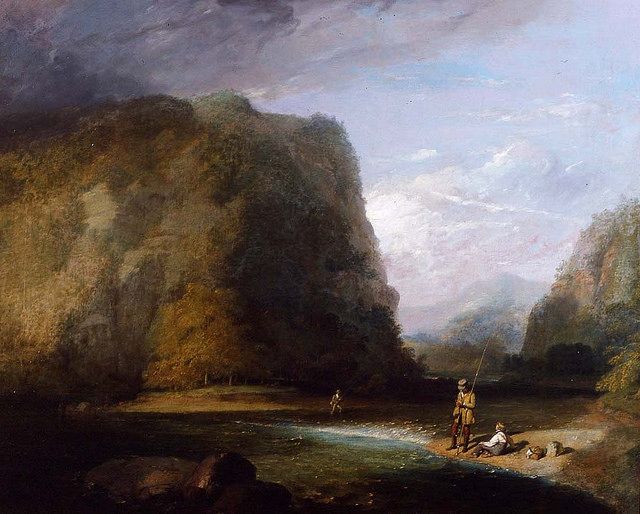
    Trout Fishing in Sullivan County, New York. By: Henry Inman.

    In the 15 years leading up to the Civil War, a wide variety of theories emerged for how the federal government should deal with slavery expanding, or not expanding, into the territories acquired by the United States.

    (more…)

  • The Role of Slavery in Splitting America

    underground_railroad
    The Underground Railroad. By: Charles T. Webber.

    Since the outbreak of the Civil War and continuing to the present day, the role of slavery in splitting America has been hotly debated. One may wonder whether there was merely a correlation between slavery and the Civil War or whether slavery was the cause. Investigating the nuances of the issue of slavery reveals that the Civil War resulted from sectionalism and slavery, which were practically synonymous.

    (more…)