Tag: States’ Rights

  • America in 1848

    154
    John Calhoun.

    In 1848, when word spread to America that a revolution was breaking out in France, President James Polk wrote: “The great principles of popular sovereignty which were proclaimed in 1776 by the immortal author of our Declaration of Independence, seem now to be in the course of rapid development throughout the world.” James Knox Polk to Richard Rush, April 18, 1848, quoted in Michael Morrison, “American Reactions to European Revolutions, 1848-1852,” Civil War History 49 (June 2003): 117.

    (more…)

  • The First Presidential Succession

    Portrait of John Tyler
    Depiction of John Tyler.

    Following William Henry Harrison’s death just a month into his presidency in 1841, John Tyler rose to the presidency, in the first instance of a president dying while holding the office. See Daniel Walker Howe, What Hath God Wrought: Transformation of America, 1815-1848, 589.

    (more…)

  • The Supreme Court Under Jackson

    roger_b-_taney_-_brady-handy
    Roger B. Taney. Photograph by: Mathew Brady.

    John Marshall, perhaps the greatest Chief Justice of the Supreme Court of the United States, died on July 6, 1835. As his life was coming to a close, he wrote Joseph Story, “I yield slowly and reluctantly to the conviction that our constitution cannot last.” Daniel Walker Howe, What Hath God Wrought: Transformation of America, 1815-1848, 439 quoting John Marshall to Joseph Story, Sept. 22, 1832, quoted in Kent Newmyer, John Marshall and the Heroic Age of the Supreme Court (Baton Rouge, 2001), 386.

    (more…)

  • Challenging White Supremacy

    david_walker_appeal
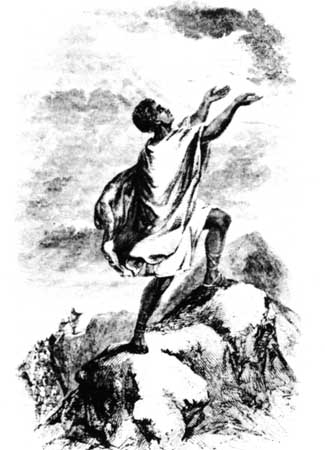
    Frontispiece of David Walker’s Appeal Pamphlet.

    In the midst of President Andrew Jackson’s presidency, white supremacy was becoming a prominent principle in American society, facilitating confrontation between whites and blacks but also between whites and Native Americans. Just months into Jackson’s first term, David Walker published a controversial and incendiary pamphlet: An Appeal to the Colored Citizens of the World, But in Particular, and Very Expressly, to Those of the United States of America. (more…)

  • The Fort Hill Address

    Personalities AE  6
    John Calhoun.

    John Calhoun, by 1831, had alienated himself from President Andrew Jackson, and he wanted to “head off talk of secession,” and on July 26, 1831, he published his “Fort Hill Address” in a South Carolina newspaper. Daniel Walker Howe, What Hath God Wrought: Transformation of America, 1815-1848, 399.

    (more…)

  • Liberty and Union, Now and Forever, One and Inseparable

    daniel_webster
    Daniel Webster.

    In 1830, Daniel Webster, Senator from Massachusetts, engaged in a heated debate with Robert Hayne, Senator from South Carolina, which touched on the political theory of federal and state sovereignty.

    (more…)

  • The Panic of 1819

    william-jones
    William Jones. Artist Unknown.

    America’s reliance on cotton as an economic staple presented an opportunity for prosperity and an accompanying risk. In late 1818, the value of cotton fell as supply outpaced demand and “London banks decided there was no longer a need to extend more credit.” Daniel Walker Howe, What Hath God Wrought: Transformation of America, 1815-1848, 142. Then, the Second Bank of the United States, just two years into its life, “responded by shifting suddenly away from its own expansionist policy,” by the direction of William Jones, which only exacerbated the credit problem. See id. at 142-43. The Panic of 1819 erupted.

    (more…)