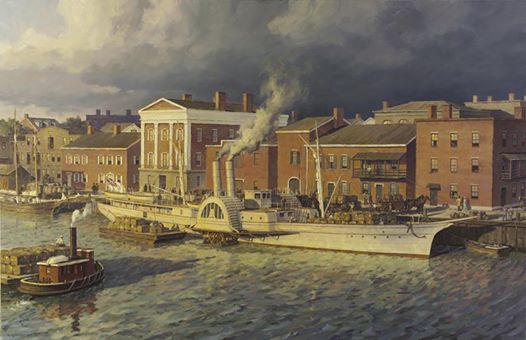
Throughout the Civil War, the Union navy encircled the Confederacy’s ports and confiscated property that was entering or exiting the country in an effort to restrict the Confederate economy. While its full effect may be debated, it played a significant role in reducing the Confederacy’s foreign trade and consequently the strength of its economy and ability to conduct the war.
Tag: Union
-

The Anaconda Plan
Although George McClellan succeeded Winfield Scott as general in chief of the Union army in late 1861, Scott had already set a plan in motion that would, in one form or another, last the duration of the war. It was a plan that would be a factor in constricting the Confederate economy, choking the Confederacy into a defensive posture from which it would be impossible to escape. (more…)
-

The Preparedness of the Union and Confederacy
At the outset of the Civil War, the discrepancies between the Union and Confederate armies were evident. Despite their differences in background and appearance, both sides were poised to not only revolutionize the American method of warfare but also to change life for civilians throughout the country. (more…)
-
The First Battle of Bull Run
Three months after the firing on Fort Sumter, the Confederacy and Union had produced armies capable of fighting and mobilized to northern Virginia; roughly halfway between Washington and Richmond. There, near a “sluggish, tree-choked river” known as Bull Run, the first major battle following the secession of the South would occur.[i] (more…)
 Last Best Hope of Earth