While America had A Tradition of Extra-Legislative Action, including mobs and demonstrations, in the 1830s, America took a turn toward violence.
While America had A Tradition of Extra-Legislative Action, including mobs and demonstrations, in the 1830s, America took a turn toward violence.
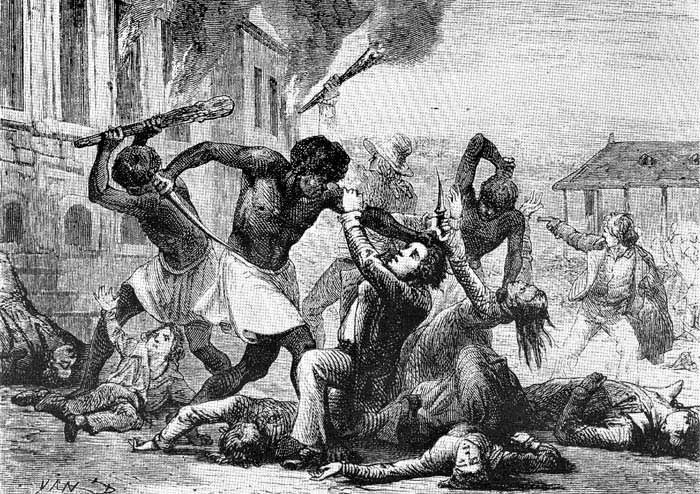
On August 22, 1831, the greatest slave rebellion in United States history occurred, led by a “mystic religious visionary named Nat Turner.” Daniel Walker Howe, What Hath God Wrought: Transformation of America, 1815-1848, 323.

Paul Cuffe, by 1816, began making voyages across the Atlantic Ocean to Africa, transporting African-Americans who wished to make a new home in Africa. Daniel Walker Howe, What Hath God Wrought: Transformation of America, 1815-1848, 260.

The debate surrounding the adoption of the Bill of Rights revealed to many Americans the stark differences between Federalists and Antifederalists. Edmund Pendleton, in the Virginia Convention, stated that opposition to the Constitution “rested on ‘mistaken apprehensions of danger, drawn from observations on government which do not apply to us.’” Gordon Wood, The Creation of the American Republic: 1776-1787, 543 quoting Pendleton (Va.), in Elliot, ed., Debates, III, 36-37. Pendleton pointed out that many governments in the world were ruled by dictators. Id. Those governments had “bred hostility between ‘the interest and ambition of a despot’ and ‘the good of the people,’ thus creating ‘a continual war between the governors and the governed.’” Id. Pendleton believed that these beliefs led Antifederalists to demand a bill of rights and to have other unfounded fears about the Constitution. Id.

Coming out of the Philadelphia Convention, many Americans had different perspectives about what had transpired and how effective the Constitution could be as a governing document.

While during the American Revolution, the judiciary was mostly forgotten, in the interest of controlling gubernatorial power by empower legislatures, that began to change during the 1780s.

Prior to the American Revolution, the colonists had become familiar with the concept of charters. Charters, whether royal, corporate, or proprietary, operated “as the evidence of a compact between an English King and the American subjects.” Gordon Wood, The Creation of the American Republic: 1776-1787, 268; see also Leonard Krieger, The Politics of Discretion: Pufendorf and the Acceptance of Natural Law (Chicago, 1965), 121.

Ancient Rome and Ancient Greece were intertwined with the American Revolution and the establishment of the American republic.

In the earliest years of the American Republic, theories were abound about the proper structure of government to best balance equality and wise decision-making. John Adams stated, in his Thoughts on Government, that “a people cannot be long free, nor ever happy, whose government is in one assembly.” Gordon Wood, The Creation of the American Republic: 1776-1787, 208-09 quoting John Adams, Thoughts on Government, Adams, ed., Works of John Adams, IV, 194, 196. These theories became tested throughout the young country, in each of the state’s constitutions.

In the months leading up to the Declaration of Independence, the states began the process of adopting their own constitutions. These constitutions, being drafted in 1776, approximately 13 years before the United States Constitution would be ratified, had to confront many of the same issues as the United States Constitution, with various approaches being taken. (more…)
 Last Best Hope of Earth