By the time of the Revolution, the states had begun to take steps toward sustaining themselves after independence from Britain was effectuated. One of those steps was the drafting of constitutions. Constitutions, while understood generally in Britain and elsewhere, had a unique meaning for Americans.
Sacrificing private interest for the public good is a noble virtue. It was an idea widely revered in the years surrounding the American Revolution. But despite the pervasiveness of that idea, some believed it was leading America down a path toward destruction. (more…)
As the American Revolution became more and more inevitable, states began contemplating the role and responsibilities of their legislatures. Those contemplations centered around curing the perceived ills and shortcomings of the English constitution.
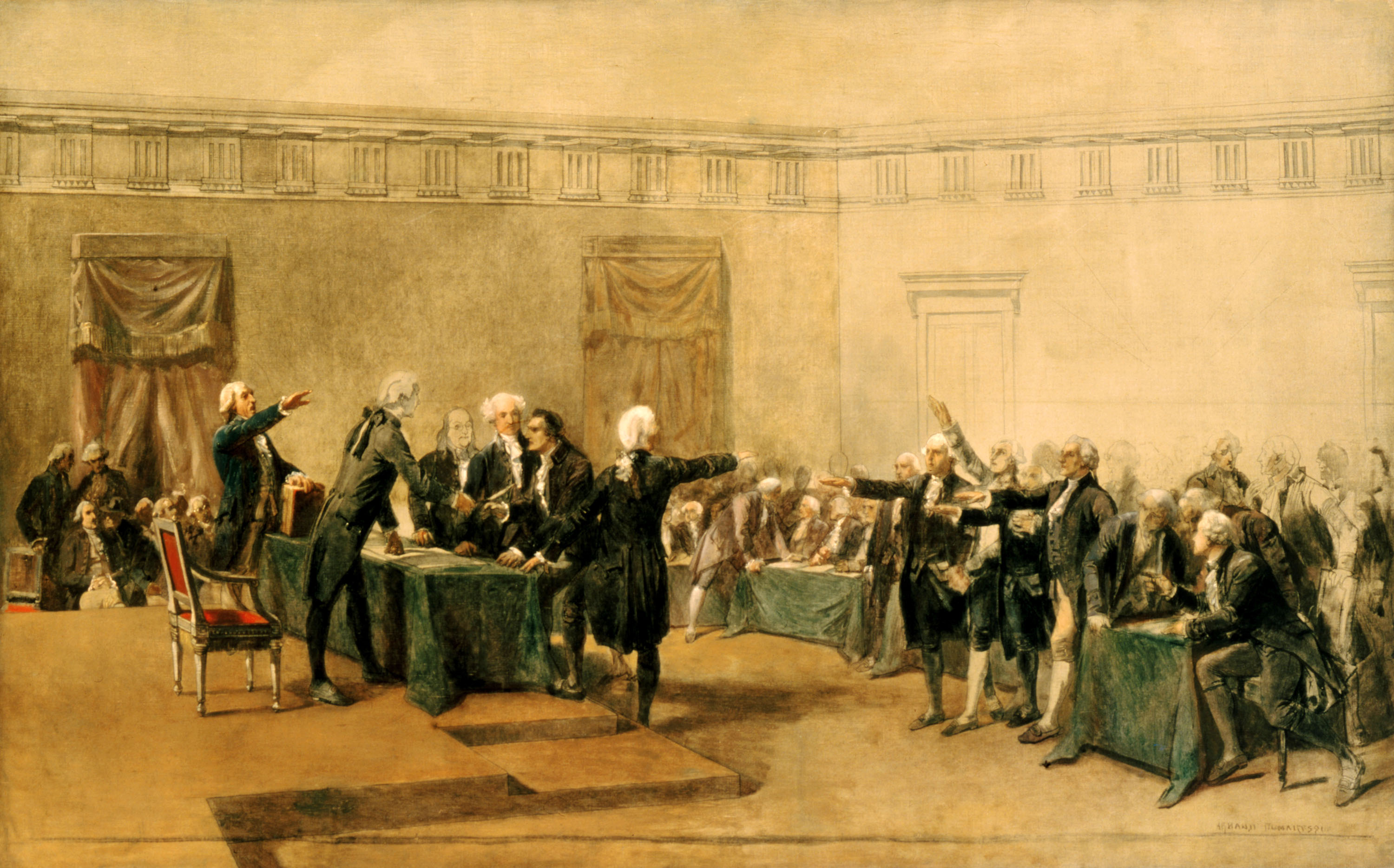
Signing of Declaration of Independence. By: Armand Dumaresq.
Tyranny, one of the early Americans’ greatest fears, may seem to contemporary Americans an unjustified fear. Perhaps that is because the early Americans’ precautionary actions relegated the threat of tyranny to the 18th Century. Perhaps not. (more…)
In the months leading up to the Declaration of Independence, the states began the process of adopting their own constitutions. These constitutions, being drafted in 1776, approximately 13 years before the United States Constitution would be ratified, had to confront many of the same issues as the United States Constitution, with various approaches being taken. (more…)
The success or failure of countries, and politicians for that matter, are an often studied subject. Studies have been ongoing for centuries.
James Burgh, an English Whig, wrote: “Almost all political establishments have been the creates of chance rather than of wisdom. Therefore it is impossible to say what would be the effect of a perfect commonwealth” as there was no precedent in history. James Burgh, Political Disquisitions, Vol. 1, 23. (more…)
The English Whigs were an influential, even revered, group for many of the colonists in America. Their beliefs resonated with ordinary, common people.
The Whigs believed that “the promotion of the people’s happiness was the sole purpose of government.” Gordon Wood, The Creation of the American Republic: 1776-1787, 20. Further, government was “a wise, a necessary, and a sacred thing,” which restrained the “lusts and passions that drove all men.” Id. quoting Samuel Williams, A Discourse on the Love of our Country (Salem, 1775), 28; John Joachim Zubly, The Law of Liberty (Philadelphia, 1775), 6-7.
The basics of the social contract were fundamental to Whig beliefs. The government officials “agreed to use their superior power to protect the rights of the people,” who “pledged their obedience, but only . . . as long as the rulers promoted the public interest.” Gordon Wood, The Creation of the American Republic: 1776-1787, 20 citing Dan Foster, A Short Essay on Civil Government (Hartford, 1775).
Many Whig leaders in England became idols for American liberty. William Pitt, the First Earl of Chatham, developed an almost cult-like following amongst a segment of colonists in America. In Bristol County, Massachusetts, one colonist explained: “Our toast in general is,—Magna Charta [sic], the British Constitution,—Pitt and Liberty forever!” Clinton Rossiter, Seedtime of the Republic. The Origin of the American Tradition of Political Liberty (New York: Harcourt, Bruce and Company, 1953), 145, 359-60.
This early American obsession with the Whig ideology would frame the revolutionaries’ beliefs and priorities. Those beliefs and priorities have carried forward to modern Americans.
The social contract certainly has not been forgotten, as many modern Americans are fully aware of the fact that their elected officials can be voted out just as easily as they were voted in.
However, the political theory surrounding the purpose of government perhaps has been lost over the years. The Whig belief that the sole purpose of government is to promote the happiness of the people is an optimistic, hopeful perspective. Many contemporary Republicans, particularly of the Ronald Reagan era, would not be able to disagree loud and fast enough to this Whig belief. Even some modern Democrats may take issue with it, as it is perhaps not nuanced enough to apply to a nuanced society.
While we were quick to import the Whig belief that government’s sole purpose is to promote happiness, should we, as modern Americans be so quick to dismiss it? If the purpose of government is not happiness for all, then what is it?
For many colonists and early Americans, politics was a contentious, yet simple subject. Many believed that politics “was nothing more than a perpetual battle between the passions of the rulers, whether one or a few, and the united interest of the people.” Gordon Wood, The Creation of the American Republic: 1776-1787, 18.
Thomas Gordon, an Englishman and a Whig, wrote that “[w]hatever is good for the People is bad for their Governors; and what is good for the Governors, is pernicious to the People.” Id.quoting John Trenchard and Thomas Gordon, Cato’s Letters: Or, Essays on Liberty, Civil and Religious, and Other Important Subjects, 5th ed. (London, 1748), II, 249.
These beliefs defined the Whigs, the Americans who identified with the British Whig political party led by Charles James Fox. The British Whigs were adamantly opposed to a strong monarchy. Later, in the 1830s, a movement would emerge in America called the Whig Party, which was opposed to a strong presidency.
The American Revolution developed these views in a uniquely American way. The British Whigs were focused on restraining the power of one of the mightiest empires, led by a monarchy, the world has ever known. They hoped to displace the Tories, the political party who supported the powerful monarchy. Colonists in America who embraced the Whig ideology realized that to prevent such a dilemma from playing out in America, those colonists had to develop new systems and institutions that prevented such a concentration of power in the government.
Despite the colonists progress in creating those systems and institutions, the dynamic that Whigs identified between rulers and their people still resonates today. Many modern Americans believe that government officials will inevitably only cater to the interests of government officials, not the common people. Some say it is human nature and no amount of political theorizing can conjure up a system that prevents it from happening.
One has to wonder, does the American system’s representative nature not curtail that dynamic from occurring? Has America effectively addressed rulers only looking out for rulers?




 Last Best Hope of Earth