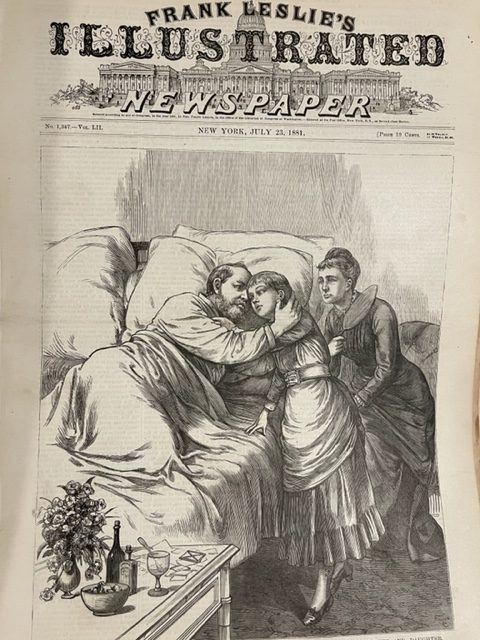
In the late afternoon, during the summer, a thunderstorm rolled its way through the nation’s capital. Although it first had the effect of cooling the thick Washington air, the effect was fleeting. By 10 o’clock that night, the President could have hope for relief: a new apparatus—rumored to be quite effective against the oppressively humid air of India—had arrived. Staff assembled V-shaped troughs, made of zinc and “filled with ice and water,” and placed them under the windows of the President’s room.[i] The water lessened the humidity, and the ice cooled the air entering the room through the windows.[ii] The President’s pulse, temperature, and respiration satisfied his physicians, and there was optimism that “the worst was over.”[iii] It had been several weeks since the attempted assassination, and the 20th President of the United States, James Garfield, was having his secretaries attend to the pressing matters of the country as he rested.[iv] His wife and children visited his bedside, and his daughter, Mollie, “nestled her fresh face in his beard,” keeping her composure just as her mother did.[v] The President “kissed her and stroked her hair, and then she took a seat near her mother” when the “boys came in presently with manful bearing and remained a few minutes.”[vi] The cooling apparatus, the doctors said, was not giving “entire satisfaction,” and a new device—one that was “similar to that used in the mines to cool the air and send it into the chamber through the registers”—was set to be installed to relieve the President from his symptoms.[vii]
(more…)Tag: William Sherman
-
Tightening the Cordon
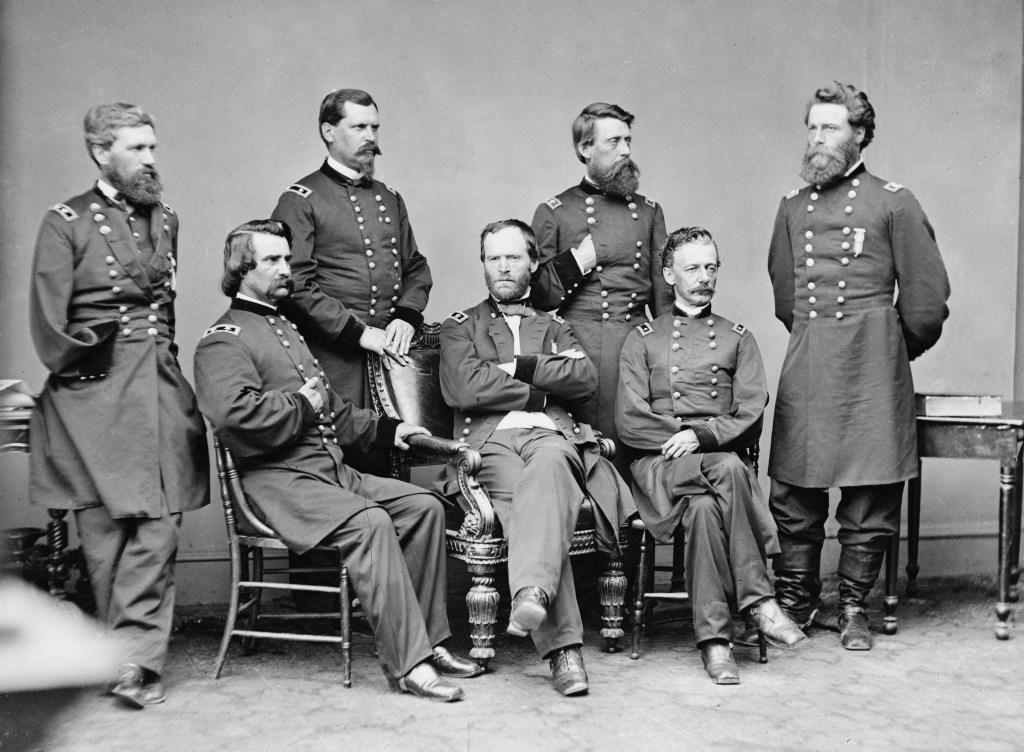
By the end of 1864—with Union General William Tecumseh Sherman having cut his way through Georgia, Union General Ulysses S. Grant having confined Confederate General Robert E. Lee to a defensive position in Virginia, and President Abraham Lincoln having won his bid for re-election—the Confederacy was desperate for any sign of encouragement. While the rhetoric from Confederate President Jefferson Davis and Vice President Alexander Stephens had remained buoyant, and despite newspaper headlines throughout the South continuing to cheer for the cause, the Confederacy was nowhere near the crest it had enjoyed in 1863. Having lost the chance to put the Union on the defensive that year, the rebels now found their western and southern borders closing in on them. If ever there was going to be a negotiated peace, the chances of it occurring were rapidly diminishing as 1865 dawned. (more…)
-

The March to the Sea
Throughout the Civil War, soldiers and citizens alike could view the events unfolding before them and question whether there was a better alternative than to prosecute the war to its bitter end. What had started as a spectator’s war—with men and women gathering near the battlefields to picnic and take in the action—had morphed, by mid-1864, into slaughter with the only variables being where the slaughter may occur and what magnitude it may reach. One veteran lieutenant recalled after the war, “As we lay there watching the bright stars, many a soldier asked himself the question: What is this all about? Why is it that 200,000 men of one blood and one tongue, believing as one man in the fatherhood of God and the universal brotherhood of man, should in the nineteenth century of the Christian era be thus armed with all the improved appliances of modern warfare and seeking one another’s lives? We could settle our differences by compromising, and all be at home in ten days.”[i] Of all the soldiers that gazed at the bright stars and asked themselves these questions, the men under the command of Union General William Tecumseh Sherman were not a part of that group when they left Atlanta burning and began a campaign through the heart of Georgia to the Atlantic Ocean. (more…)
-

The Taking of Atlanta
According to Confederate President Jefferson Davis, the fall of Atlanta into Union hands would “open the way for the Federal Army to the Gulf on the one hand, and to Charleston on the other, and close up those rich granaries from which Lee’s armies are supplied. It would give them control of our network of railways and thus paralyze our efforts.”[i] The strategic location of the city was only one of several reasons for the Confederates to hold it: Atlanta had seen tremendous growth during the war with “foundries, factories, munitions plants, and supply depots” having sprung up on account of the city becoming a railroad hub.[ii] Capturing the city became the primary goal of Union General William Tecumseh Sherman, but, because the rebels had come to see the city as being second only to Richmond as a “symbol of resistance and nationality,” the campaign to Atlanta was almost certain to be easier than taking Atlanta.[iii] (more…)
-
The Atlanta Campaign

Battle of Kennesaw Mountain. By: Thure de Thulstrup. Courtesy: U.S. Department of the Interior. After over four years of fighting, the North and the South had become increasingly fatigued with the war and anxious for its resolution. Throughout the Confederacy, hope was growing that the Union, rather than continue to tighten its grip at the expense of casualties on both sides, would agree to a negotiated peace. Standing in the way of that result was President Abraham Lincoln who had expected nothing less than a total victory. While the Union generals led by Ulysses S. Grant had achieved progress by taking territory in the west and cutting off resources to the Confederate capital, for each of the past four years, momentum had stalled whenever any general, including Grant, had come within earshot of Richmond. With the election of 1864 approaching, the rebels saw the potential for the northern electorate to oust Lincoln and bring a president to Washington that would negotiate an end to the war. (more…)
-

The Battle of the Wilderness
By the spring of 1864, changes were abound on the Union side. Three generals—Ulysses S. Grant, William Tecumseh Sherman, and Philip Sheridan—had become the preeminent leaders of the northern army. With Congress having revived the rank of lieutenant general, a rank last held by George Washington, President Abraham Lincoln promoted Grant to that rank and bestowed on him the title of general in chief.[i] While the North was in the ascendancy, the Confederate army had suffered through the winter. The Confederate Congress had eliminated substitution, which had allowed wealthy southerners to avoid conscription, and “required soldiers whose three-year enlistments were about to expire to remain in the army.”[ii] Even with Congress taking the extraordinary step of adjusting the draft age range to seventeen years old through fifty years old, the rebels still numbered fewer than half their opponents.[iii] Nonetheless, hope was not lost: a camaraderie pervaded the Southern army—particularly amongst the many veteran soldiers—which was perhaps best encapsulated in General Robert E. Lee’s saying that if their campaign was successful, “we have everything to hope for in the future. If defeated, nothing will be left for us to live for.”[iv] (more…)
-
The Siege of Vicksburg
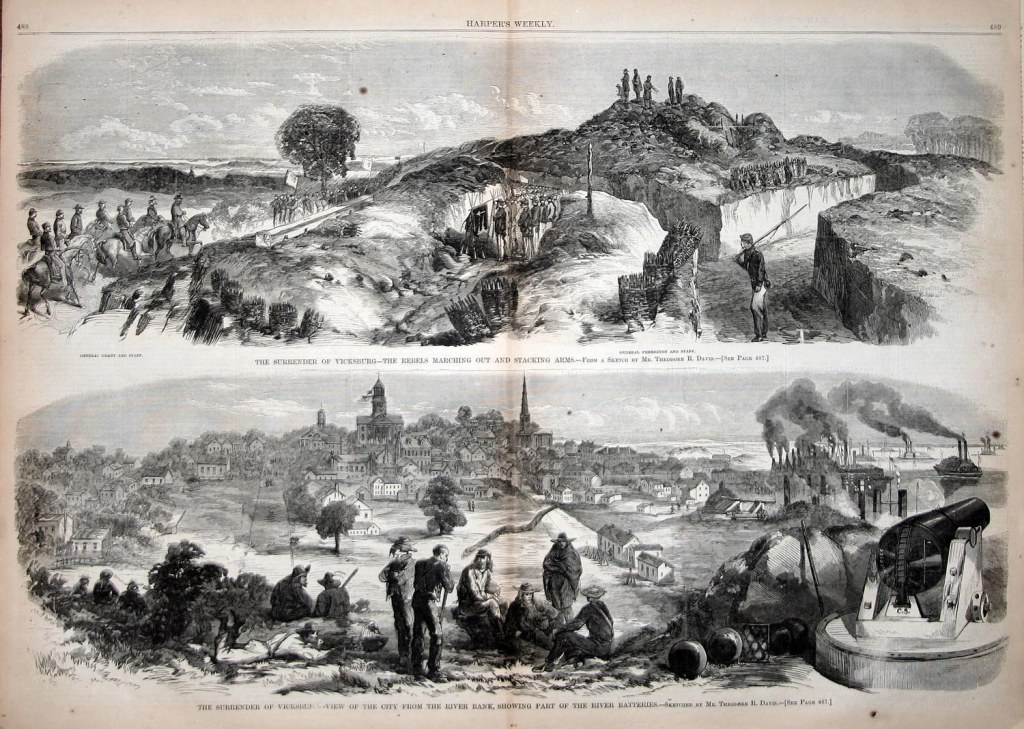
In the western theater of war, Ulysses S. Grant had set his sights on a goal early in his campaigning: Vicksburg, a town hugging the Mississippi River on the border of Louisiana and Mississippi. Taking the city would not only secure the Mississippi River; taking it would give the Union a lasso around the Confederacy. Just as spring of 1863 was getting underway, Grant had drawn up a plan to take the town and tighten the Union grip on the Confederacy. (more…)
-
The Battle of Shiloh
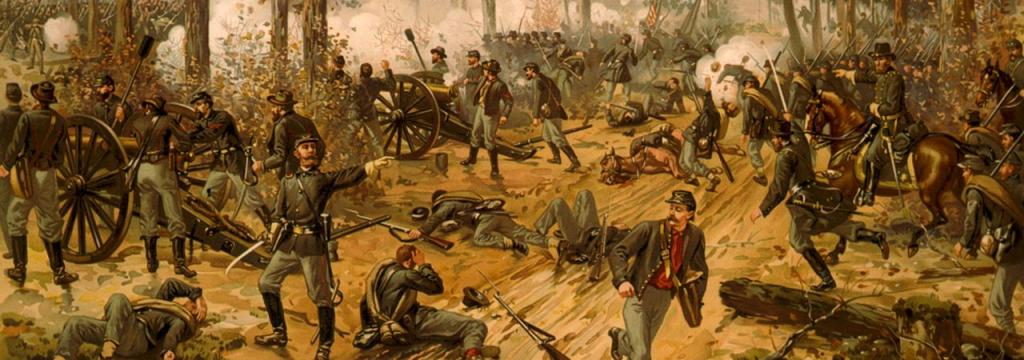
Two of the greatest Confederate generals in early 1862, Albert Sidney Johnston and P.G.T. Beauregard, rendezvoused in Corinth, Mississippi with a combined 42,000 men.[i] The city not only could serve as an origin point of a campaign into nearby Tennessee; it also was the meeting point for the Confederacy’s “main north-south and east-west railroads.”[ii] Given Corinth’s importance, Henry Halleck ordered Ulysses S. Grant to march his men to Pittsburg Landing, wait for his fellow general Don Carlos Buell to arrive with his army, and then move on Corinth as a combined force numbering approximately 75,000.[iii]
-

The Battle of Belmont
When fighting erupted between Confederate and Union forces in Mississippi County, Missouri, few could have expected that one man, a newly-promoted Brigadier General, would emerge from obscurity and tragedy and begin his upward trajectory to the heights of American myth and legend. Nonetheless, at the end of the Battle of Belmont, that man—Ulysses S. Grant—had secured himself admiration from his commanders and established a brand of warfare that would later elevate him up the ranks and define the Union’s conduct of the war. (more…)
-
The First Battle of Bull Run
Three months after the firing on Fort Sumter, the Confederacy and Union had produced armies capable of fighting and mobilized to northern Virginia; roughly halfway between Washington and Richmond. There, near a “sluggish, tree-choked river” known as Bull Run, the first major battle following the secession of the South would occur.[i] (more…)
 Last Best Hope of Earth