Author: Last Best Hope of Earth

  • Election of 1848: The Candidates

    hd_1848electiontopic
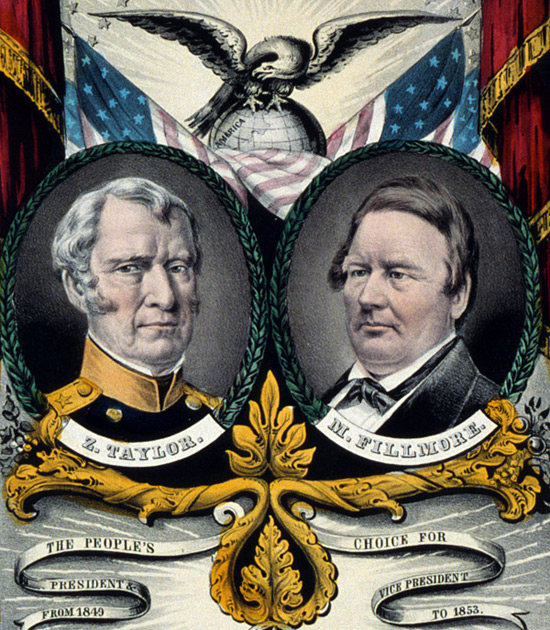
    The Whig Ticket for President, Zachary Taylor, and Vice President, Millard Fillmore.

    The Election of 1848 was bound to be unique, as President James Polk had made clear that he would serve only one term as president. With that, the Whigs and the Democrats had to put forth candidates that could meet the parties’ respective goals of reversing President Polk’s policies (the Whigs) and expanding on President Polk’s policies (the Democrats).
    (more…)

  • The Mass Immigration of the 1840s

    five_points_new_york_city_1852
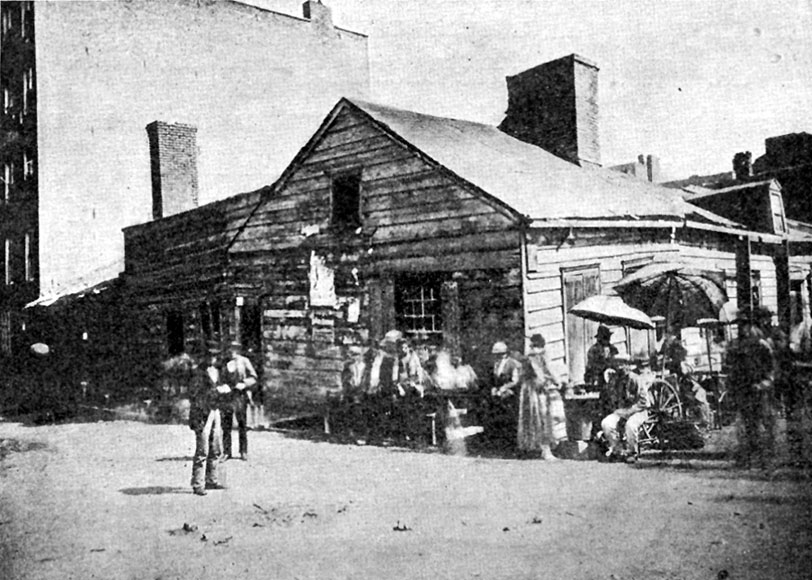
    Photograph of the Five Points Neighborhood of New York City. Photographer Unknown.

    In the mid-1840s, the last major famine in European history would take place in Ireland. This famine would have significant ramifications for America, as it would lead to a massive wave of immigrants.

    (more…)

  • The Gold Rush of 1849

    miners_
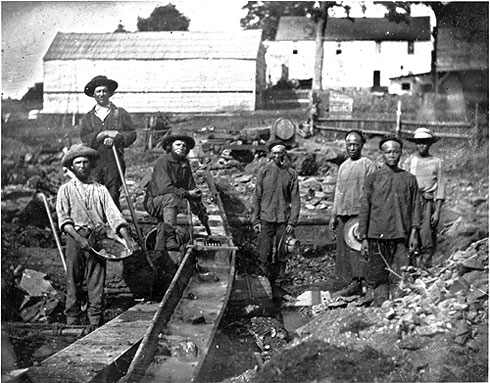
    Gold Miners During the California Gold Rush. Photographer Unknown.

    On January 24, 1848, James Marshall and Johann Sutter made a discovery that would transform the territory of California and bring about pandemonium in American society. The specks of gold that they discovered, while they may have hoped to keep secret, were anything but a secret.

    (more…)

  • The Death of John Quincy Adams

    john_quincy_adams_daguerreotype_c1840s
    Daguerrotype of John Quincy Adams.

    One of the most outspoken Representatives in the House of Representatives, John Quincy Adams, had opposed the declaration of war on Mexico and fought President James Polk’s policies for the duration of his presidency.

    (more…)

  • The Treaty of Guadalupe Hidalgo

    treaty_of_guadalupe_hidalgo
    The Treaty of Guadalupe Hidalgo.

    With the execution of the Treaty of Guadalupe Hidalgo, the Mexican-American War had come to an end. The territory that Mexico relinquished to America held “some ninety thousand Hispanics and a considerably larger number of tribal Indians,” despite President James Polk characterizing the territory as “almost unoccupied.” Daniel Walker Howe, What Hath God Wrought: Transformation of America, 1815-1848, 809.

    (more…)

  • Constitution Sunday: “Publius,” The Federalist IX [Alexander Hamilton]

    “Publius,” The Federalist IX [Alexander Hamilton]

    Independent Journal (New York), November 21, 1787

    Following are excerpts from Alexander Hamilton’s writings in the Federalist Papers:

    “When Montesquieu recommends a small extent for republics, the standards he had in view were of dimensions, far short of the limits of almost every one of these States. (more…)

  • Polk’s Expansion of Presidential Power

    james_knox_polk_by_george_peter_alexander_healy_detail_1846_-_dsc03261
    James Polk. By: George Peter Alexander Healy. (Detail).

    The Treaty of Guadalupe Hidalgo was the culmination of the Mexican-American War and “embodied the objectives for which [President James] Polk had gone to war.” Daniel Walker Howe, What Hath God Wrought: Transformation of America, 1815-1848, 808.

    (more…)

  • Lincoln’s Spot Resolutions

    hd_ldfootracez-preview
    Political Cartoon Depicting Abraham Lincoln.

    At the end of the Mexican-American War, President James Polk proposed taking as much as Mexico’s land as possible. However, he proposed this plan to a majority Whig House of Representatives.

    (more…)

  • America in 1848

    154
    John Calhoun.

    In 1848, when word spread to America that a revolution was breaking out in France, President James Polk wrote: “The great principles of popular sovereignty which were proclaimed in 1776 by the immortal author of our Declaration of Independence, seem now to be in the course of rapid development throughout the world.” James Knox Polk to Richard Rush, April 18, 1848, quoted in Michael Morrison, “American Reactions to European Revolutions, 1848-1852,” Civil War History 49 (June 2003): 117.

    (more…)

  • The Persecution of Winfield Scott

    genwscott-engraving
    Engraving of Winfield Scott.

    Throughout the course of the Mexican-American War, General Winfield Scott was increasingly becoming a hero to Americans. While many Americans looked at Scott’s actions and could only admire him, one man took action to ensure Scott would not have a pristine reputation. That man was President James Polk.

    (more…)