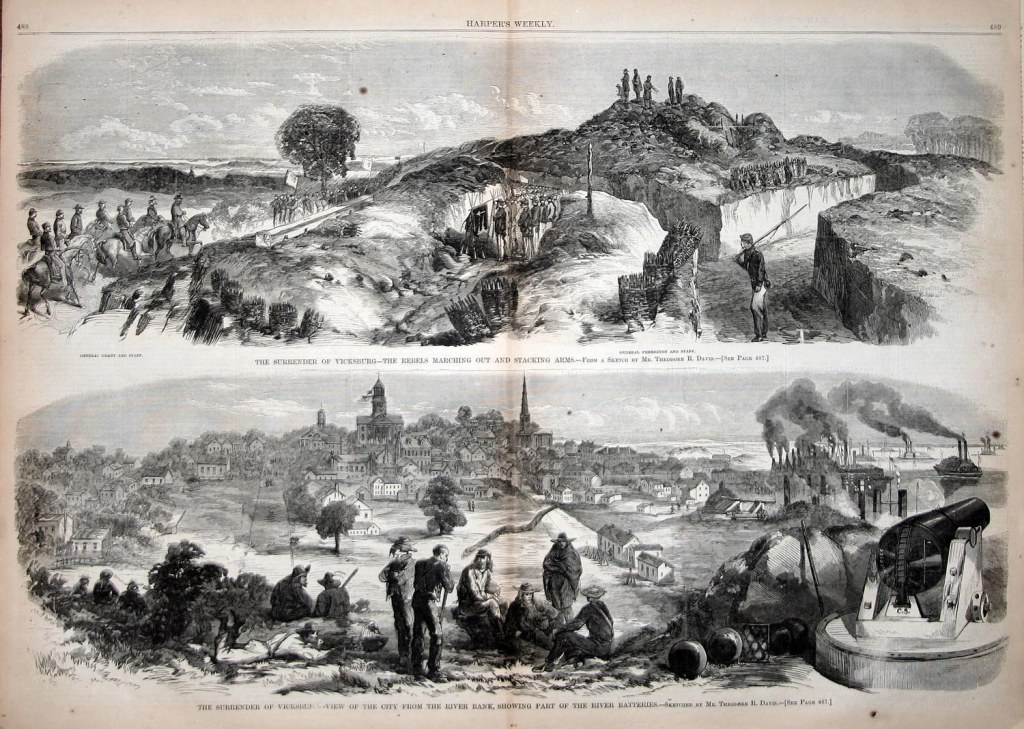
In the western theater of war, Ulysses S. Grant had set his sights on a goal early in his campaigning: Vicksburg, a town hugging the Mississippi River on the border of Louisiana and Mississippi. Taking the city would not only secure the Mississippi River; taking it would give the Union a lasso around the Confederacy. Just as spring of 1863 was getting underway, Grant had drawn up a plan to take the town and tighten the Union grip on the Confederacy. (more…)
Tag: Abraham Lincoln
-
The Battle of Chancellorsville
Joseph Hooker, at the head of the Army of the Potomac, was filled with confidence that he would not suffer the same fate as previous Union commanders facing Confederate General Robert E. Lee. While General Ambrose Burnside and General George McClellan earned their soldiers’ admiration with their leadership, they respectively fell at Fredericksburg and during the Peninsula Campaign and appeared to lack the incisive strategy to defeat Lee. (more…)
-
The Emancipation Proclamation
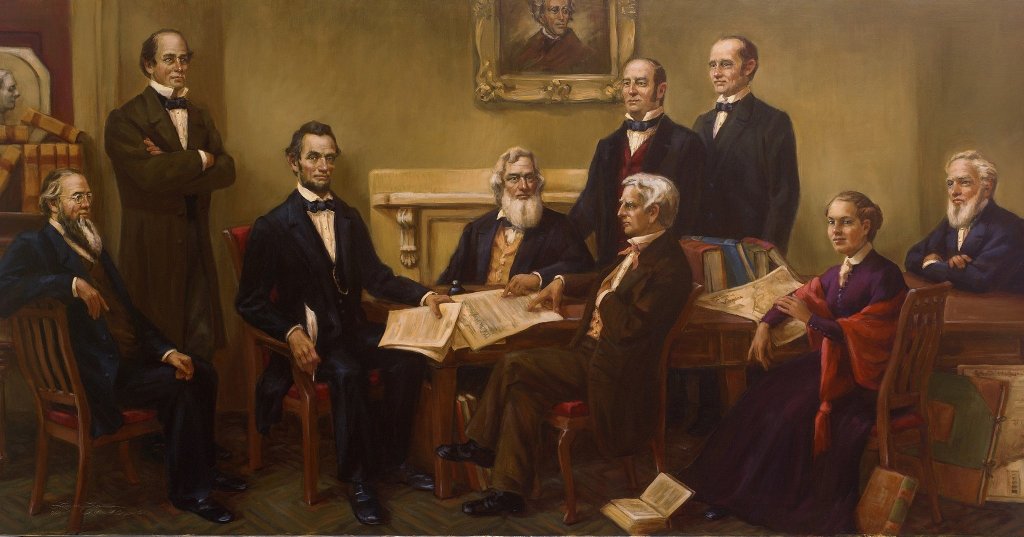
American history is replete with instances of the public pressuring a president to take action on an issue. On far fewer occasions, presidents, through speaking to voters, calling for congressional action, or issuing executive orders, have risked political capital to lead the public to advance on a prominent issue. In the middle of 1862, President Abraham Lincoln convened his Cabinet to discuss taking action on an issue that had been consuming him for weeks but was likely to endanger his bid for reelection in 1864 and was certain to change the direction of the ongoing and increasingly bloody Civil War. (more…)
-
The Battle of Fredericksburg
Throughout 1862, the Union embraced a defensive, passive approach to prosecuting the Civil War—shying away from incisive troop movements and relentless pursuits even after battles that left Confederates fatigued and fleeing—while the Confederacy had most recently displayed its more aggressive strategy by its attack near the Antietam Creek in Maryland. At the helm of the Union army, and the epitome of its quiescent nature, stood General George McClellan: a man who had come under fire for his failed Peninsula Campaign and refusal to pursue Confederate General Robert E. Lee after the Battle of Antietam. The latter decision prompted action from the White House. President Abraham Lincoln, whom McClellan had labeled as the “Gorilla,” replaced McClellan with General Ambrose E. Burnside on November 7, 1862.[i] (more…)
-
The Second Battle of Bull Run
After General George McClellan’s campaign to take Richmond fell flat, he became even more disenchanted with the Lincoln administration but vowed that if provided with 50,000 men, he would mount another attack on the Confederate front.[i] Whether a man who had “lost all regard and respect” for President Lincoln and had called the Lincoln administration “a set of heartless villains” was dedicated to restoring the Union became a question for years to come, and Lincoln recognized that even if he sent 100,000 men, McClellan would find Confederate General Robert E. Lee to have 400,000.[ii] Regardless, a Union general from the Western Theater, John Pope, had come to the Eastern Theater prepared to replace McClellan as the top commander in the East and take on the Confederates with the tenacious and fearless approach to fighting that had characterized the western battles.[iii] (more…)
-

McClellan’s Peninsula Campaign
General George McClellan, commanding 400 ships, 100,000 men, 300 cannons, and 25,000 animals, prepared to execute one of the greatest invasions in the history of the American military: a plan to take the Virginia Peninsula, a perceived weak point in the Confederacy, and march on Richmond.[i] He brought hope to his men that they would be part of the greatest campaign not just of 1862 but in military history. However, President Abraham Lincoln anticipated that it would be a futile effort as the Union men would “find the same enemy, and the same, or equal [e]ntrenchments” on which they had fruitlessly tried to advance before.[ii] Worse than that, he feared that the Confederates would take advantage of the massive Union deployment on the Peninsula and march on Washington. (more…)
-

Preparing for Invasion

Abraham Lincoln Meeting with His Cabinet in 1862. By: Francis Bicknell Carpenter. From the Union perspective, the dawn of 1862 presented as good an opportunity as ever for an attack on Richmond. If successful, it could force the Confederacy into surrendering and negotiating its reconciliation with the federal government with the only question being the extent of the retribution for secession. However, to be a successful strike on the Confederate capital, Abraham Lincoln must have known that military leadership as well as his administration heads would need to flawlessly execute a plan. This was particularly true given the Confederacy’s posture in the war: one that was entirely comfortable maintaining the status quo of defending its territory from the aggressor. (more…)
-
The Battle of Fort Donelson
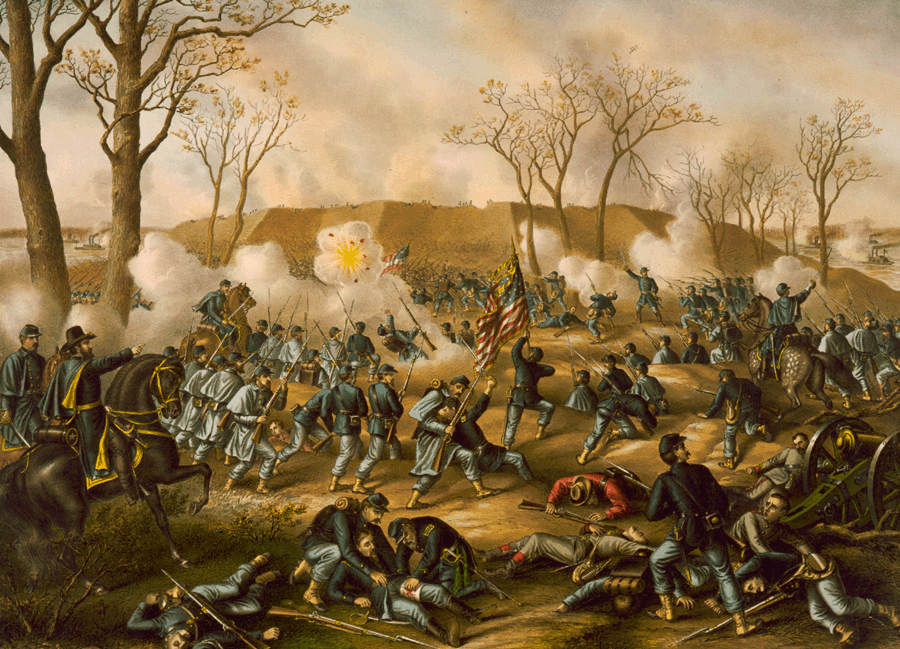
Sited on the banks of the Cumberland River and only a matter of miles from Fort Henry, Fort Donelson was slated for Union assault even before General Ulysses S. Grant’s taking of Fort Henry. The close proximity between the two forts ensured that the Confederates would not be taken by surprise when Grant went onto Fort Donelson, but both sides knew that the ceding of Donelson would be a swift second defeat in a matter of days and inspire the Union to make further advances into Tennessee and Kentucky.
-

The Anaconda Plan
Although George McClellan succeeded Winfield Scott as general in chief of the Union army in late 1861, Scott had already set a plan in motion that would, in one form or another, last the duration of the war. It was a plan that would be a factor in constricting the Confederate economy, choking the Confederacy into a defensive posture from which it would be impossible to escape. (more…)
-

The Battle of Ball’s Bluff
By the end of 1861, the Union changed its commander but also suffered its third major defeat; this one northwest of Washington at Ball’s Bluff on the banks of the Potomac River. (more…)
 Last Best Hope of Earth