Pamphlet by “Cato”: Thoughts on a Question of Importance Proposed to the Public, Whether it is probable that the Immense Extent of Territory acquired by this Nation at the late Peace, will operate towards the Prosperity, or the Ruin of the Island of Great-Britain?
When a nation has “Elegance and Luxury” introduced to its people, “it must be Manufacture and Commerce only, which can make a People numerous and prosperous.” So wrote Cato, and he continued by noting that when a nation has a more expansive territory, there is “less Necessity either of Manufactures or Commerce” as the “Multitude of common People, by whose Hands National Industry must be carried on, can easily find Support without them.” But, what if, as was the case with the British Empire, the territories become so far spread? Cato doubted that the same rules applied to such a situation; he predicted that manufacture and commerce were indeed still necessary for making the common people “numerous and prosperous.” And he made that prediction based on three reasons.
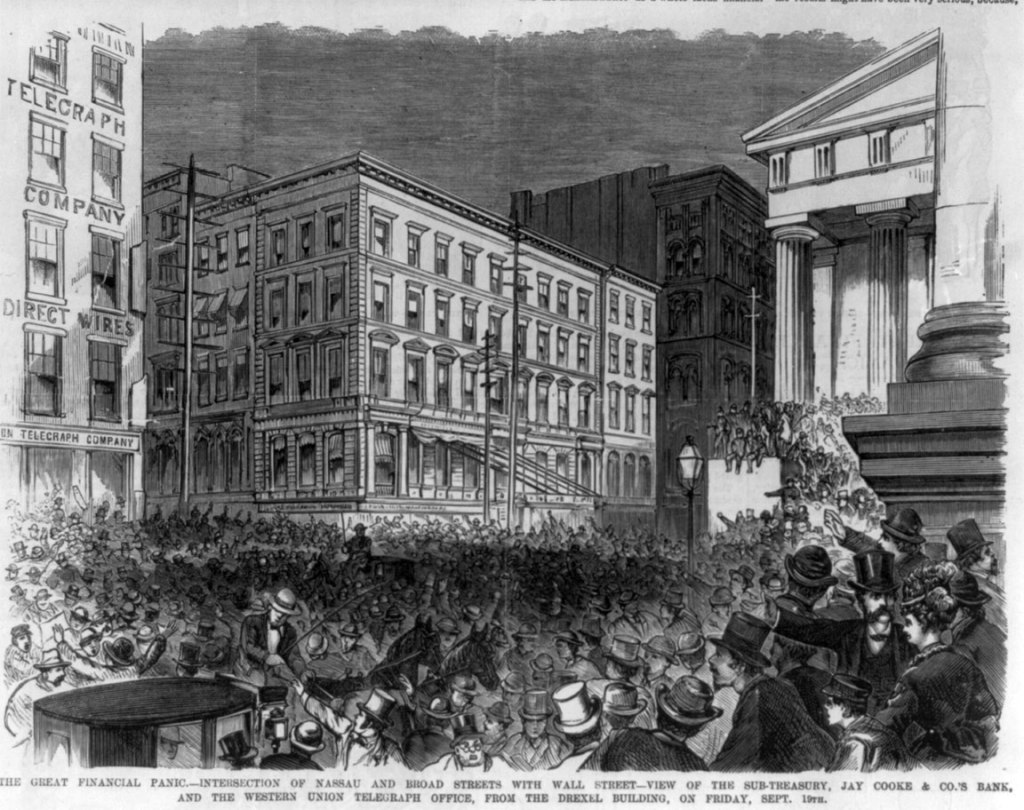
Economic crises carry with them hugely devastating results: high rates of unemployment and bankruptcy are emblematic of the more modern ones. Often, a crisis is not precipitated by a flaw in the overall economy but instead a dangerous practice in a sector of that economy. Perhaps that sector has companies or individuals who have undertaken a course of action that threatens the market, and perhaps no authority figure—governmental or otherwise—can curb or stop that dangerous behavior and prevent the damage from being done. By 1873, the American railroad industry had become an industry asking for a crisis: throughout the country—and increasingly in Europe—the American railroad companies had been a popular investment; the lure of high returns was too strong for investors to resist, and the tinderbox for the impending blaze would be the bonds of railroad companies. Those bonds were the sought after investment of the time and had been collateralized—just as a piece of real estate is collateralized for a mortgage—several times over (therefore inflating the value of the bonds, the volume of the railroad bond market, and the risk of the investments). Investors, through their greed, were guaranteeing that when the market did face a disruption—and it inevitably would—that disruption, that spark, would be the beginning of a years-long economic depression.
In Martin Van Buren’s inaugural address, in March of 1837, he boasted of the prosperity and expansion of commerce that had occurred under his predecessor, Andrew Jackson. Just months later, the Panic of 1837 would begin. Daniel Walker Howe, What Hath God Wrought: Transformation of America, 1815-1848, 502.
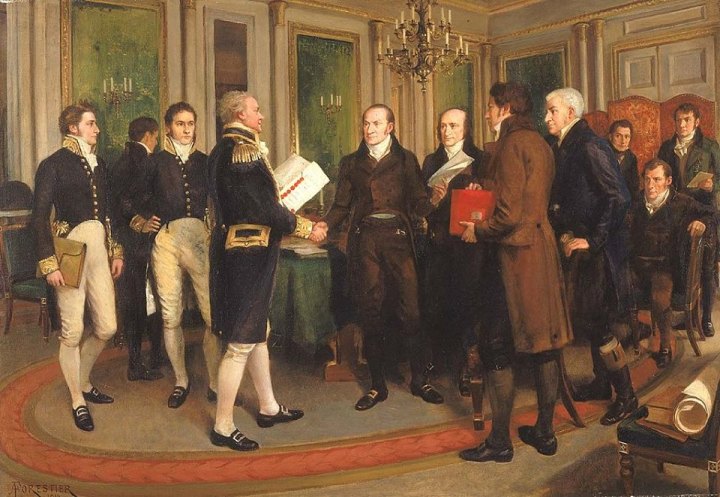
John Quincy Adams Shakes Hands with Admiral of the Fleet James Gambier. By: Amedee Forestier.
President John Quincy Adams, in his First Annual Message to Congress delivered on December 6, 1825, set forth his agenda for developing the American economy. Daniel Walker Howe, What Hath God Wrought: Transformation of America, 1815-1848, 251.
Following the end of the War of 1812, the United States underwent a transportation revolution. This transportation revolution came about as a result of Americans moving westward but also as more Americans moved into cities to engage in industrial work. Daniel Walker Howe, What Hath God Wrought: Transformation of America, 1815-1848, 212. (more…)
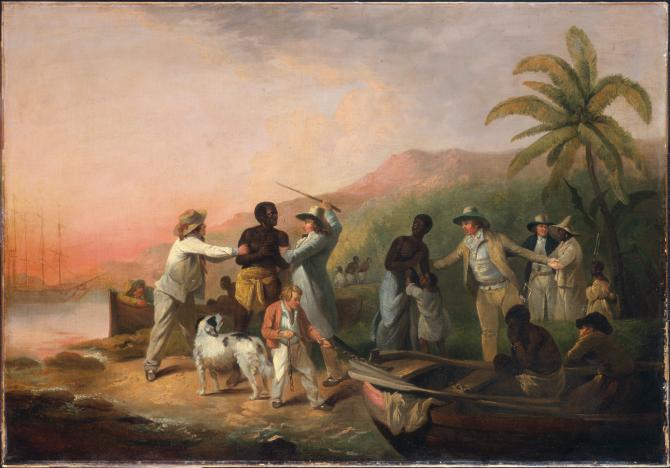
By 1815, America was already split between those states that were taking steps to eliminate slavery and those states who were fortifying their support of slavery. As the Founding Fathers had predicted, a chasm was beginning to open in the United States.
The economy of the early United States would be familiar to modern Americans in some respects but also hard to recognize, given the development of the American economy in the past two centuries.
At the beginning of the 1800s, the American economy was becoming an unconventionally successful economy. Domestic commerce was “incalculably more valuable” than foreign commerce and “the home market for productions of the earth and manufactures is of more importance than all foreign ones.” Gordon Wood, Empire of Liberty, 707 quoting Nathan Miller, The Enterprise of a Free People: Aspects of Economic Development in New York State During the Canal Period, 1792-1838 (Ithaca, 1962), 42.
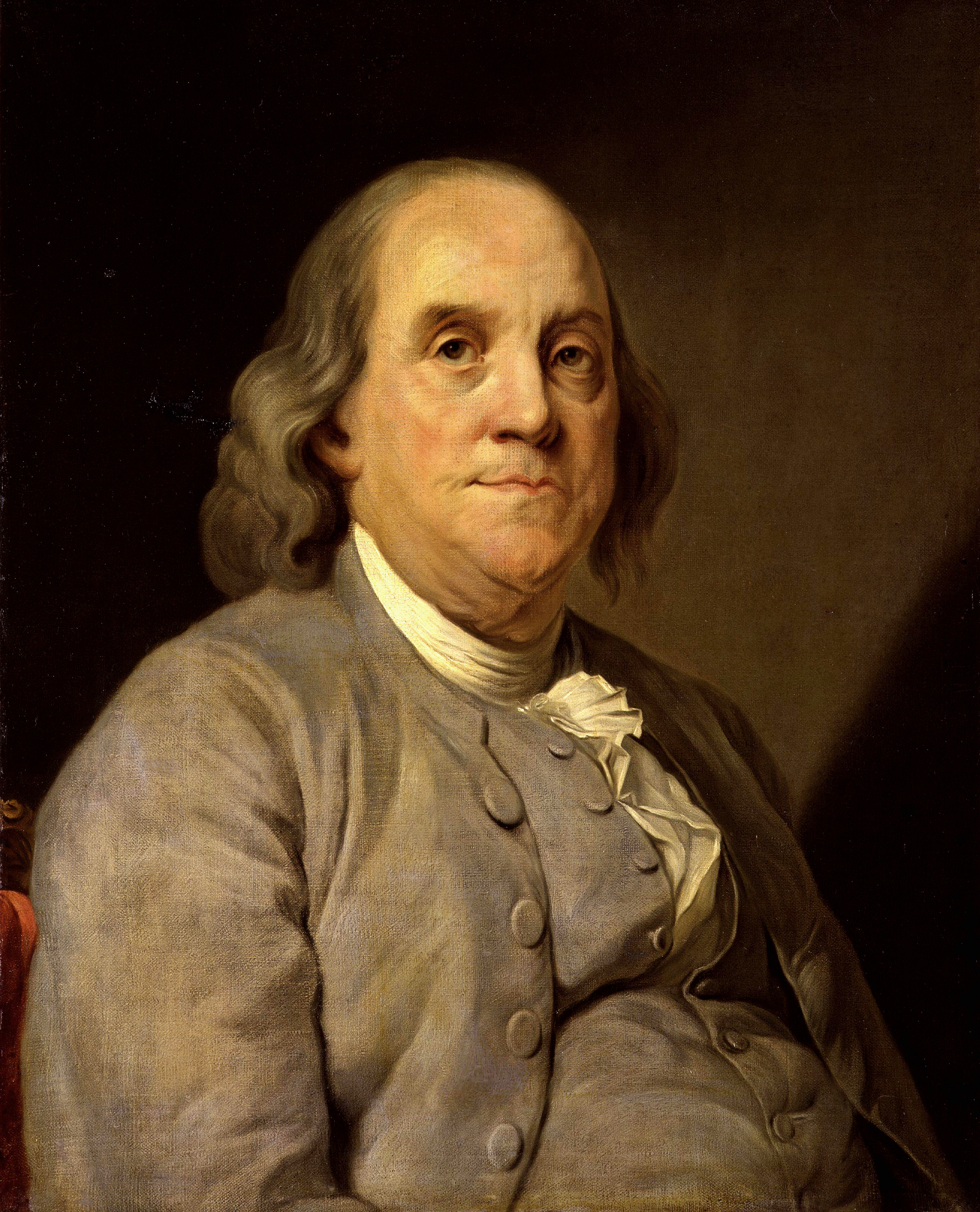
Meanwhile, a middle class was emerging in the United States. In the 1780s, Benjamin Franklin predicted “the almost mediocrity of fortune that prevails in America . . . [made] its people to follow some business for subsistence,” which made the United States “the land of labor.” Gordon Wood, Empire of Liberty, 709 quoting Benjamin Franklin, “Information to Those Who Would Remove to America” (1784), Franklin: Writings, 975-83. This new middle class was gaining “a powerful moral hegemony over the society, especially in the North.” Gordon Wood, Empire of Liberty, 709.
Both Benjamin Franklin and J. Hector St. John de Crevecoeur hoped a society could exist that lacked “both an aristocracy and a lower class.” Id. at 711. As Charles Ingersoll observed in 1810, “Were it not for the slaves of the south, there would be one rank.” Id. quoting Charles Jared Ingersoll, Inchiquin, the Jesuit’s Letters (1810), in Gordon S. Wood, ed., The Rising Glory of America, 1760-1820 (New York, 1971), 387.
These developments would lead to some to conclude that the Americans in the North were “probably the happiest people upon the earth.” J.M. Opal, Beyond the Farm: National Ambitions in Rural New England (Philadelphia, 2008), 135, 136.
These early years of the Republic, where prosperity was so widely spread that a seemingly universal middle class existed is of course a bit of an exaggeration in that there were poor and rich segments of society. But, on the other hand, the fact that so many individuals during that time commented on the subject reflects that it was a phenomenon occurring. A more cohesive, more uniform society was emerging. It was a society free from the highest highs and lowest lows that had come to characterize Europe.
Since those early years, there has been a fluctuation in the strength and size of the middle class. One thing has not changed, however. The notion of a prosperous middle class has come to be an aspiration for all Americans. The early aspirations of Benjamin Franklin and other Founding Fathers transformed this dream into a reality. That reality is one that Americans hope to carry forward for many generations to come.
In the early 1800s, America underwent a campaign of infrastructure building. The building of new roads, bridges, and canals were done in a spirit of “national grandeur and individual convenience.” Gordon Wood, Empire of Liberty, 730 quoting Charles G. Haines, Considerations on the Great Western Canal (Brooklyn, 1818), 11.
In 1806, Samuel Blodgett, an economist and architect, concluded that commerce held together the Americans. Gordon Wood, Empire of Liberty, 730. Blodgett believed that commerce was “the most sublime gift of heaven, wherewith to harmonize and enlarge society.” Id.quoting Samuel Blodgett, Economica: A Statistical Manual for the United States of America (Washington, DC, 1806), 102.
Blodgett believed that if America were to surpass Europe, it could not be done with the policies of Alexander Hamilton and the Federalists. Id. Instead, it had to be done with the Republicans, led by Thomas Jefferson. Id. Blodgett believed that only the Republican policies had the “capacity to further the material welfare of” America’s citizens. Id. citing Samuel Blodgett, Economica: A Statistical Manual for the United States of America (Washington, DC, 1806), 102.
If commerce is the “most sublime gift of heaven,” as Blodgett said, then the manifestation of commerce in the United States as being carried out with the spirit of “national grandeur and individual convenience” is the reason that America has economically surpassed the individual states of Europe. Since the days of the early Republic, Americans have taken actions that both contributed to their individual benefit and have had the aggregate effect of creating national grandeur.
In this sense, America has distinguished itself both historically and currently from other countries. Many countries, for example the Soviet Union in the past and China currently, have attempted to create national grandeur not through individual innovation but through government involvement. In doing so, those other countries have created the facade of success and grandeur that they hope to achieve. That is not to say that those countries have not developed sophisticated, successful economies. But the sustainability of those countries’ economies is debatable.
One of America’s best qualities is that it has had prolonged economic success. Of course, there have been tumultuous times, like the Great Depression, and the so-called “Great Recession” and the panics and scares that are all but forgotten in modern times.
However, America from the earliest days has encouraged individual success through its institutions, its culture, and its laws. The American people have believed in that opportunity and have taken risks, worked hard, and created an economy characterized by its national grandeur. Preserving the institutions, culture, and laws that foster such grandeur is crucial for America’s continued success.
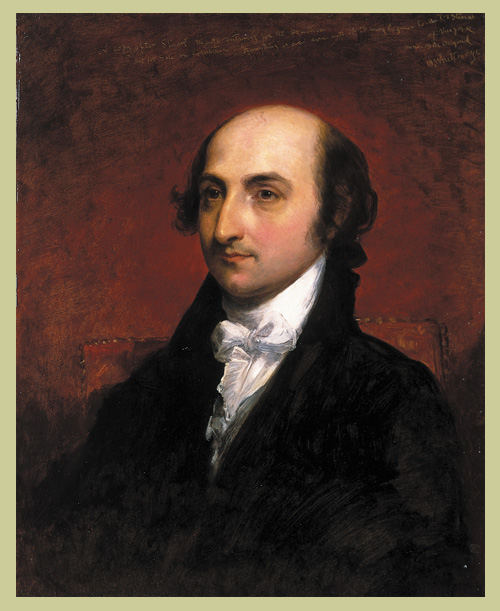
Albert Gallatin knew as early as 1799 that the United States “had become commercially and socially different from the former mother country” England. Gordon Wood, Empire of Liberty, 704. At that time, Gallatin was a Congressman, but he would later serve as Secretary of the Treasury from 1801 to 1814.
In realizing that America was different, he said that Britain had “trades and occupations” that were “so well distinguished that a merchant and a farmer are rarely combined in the same person; a merchant is a merchant and nothing but a merchant; a manufacturer is only a manufacturer; a farmer is merely a farmer; but this is not the case in this country.” Id. at 704-05 quoting Annals of Congress, 5th Congress, 3rd session (Jan. 1799), 9: 2650.
He said that if one were to venture into the middle of America, that individual would “scarcely find a farmer who is not, to some degree, a trader. In a grazing part of the country, you will find them buying and selling cattle; in other parts you will find them distillers, tanners, or brick-makers. So that, from one end of the United States to the other, the people are generally traders.” Annals of Congress, 5th Congress, 3rd session (Jan. 1799), 9: 2650.
This meant that Thomas Jefferson’s dream of Americans being a nation of agriculture and avoiding the industrialization that Europe had experienced was not a dream to be realized, even after the transformative War of 1812.
While this may have been troubling to Jefferson, Gallatin’s observations showed that Americans were developing a collective entrepreneurial spirit. Trading became an integral part of the American economy.
Part of this was inevitably by necessity, where some had to supplement their income by engaging in trading that perhaps they did not have experience in. On the other hand, part of this change from England must have been that there was a wealth of natural resources and a middle class emerging in America.
This early development after the War of 1812 should sound familiar to most modern Americans. First, although the middle class may change in size and wealth generation-by-generation, it has continually existed since the early Republic. Second, and most notably, Americans still carry an entrepreneurial spirit with them. Many would cite that entrepreneurial spirit for the success of America. It is certainly a factor.




 Last Best Hope of Earth