Tag: Capitalism

  • Constitution Sunday: Isaac Backus on Religion and the State, Slavery, and Nobility

    Massachusetts Ratifying Convention

    February 4, 1788

    Some governmental systems are engines of tyranny. They may be dressed up as virtuous systems, ones that account for all members of society, but the consequences flowing from the system always speak louder than the rhetoric its leaders spout. At the Massachusetts Ratifying Convention, in February 1788, Isaac Backus arose and spoke in favor of the draft Constitution as it accounted for and did not contain many features of a system that leads to tyranny.

    (more…)
  • The Panic of 1873

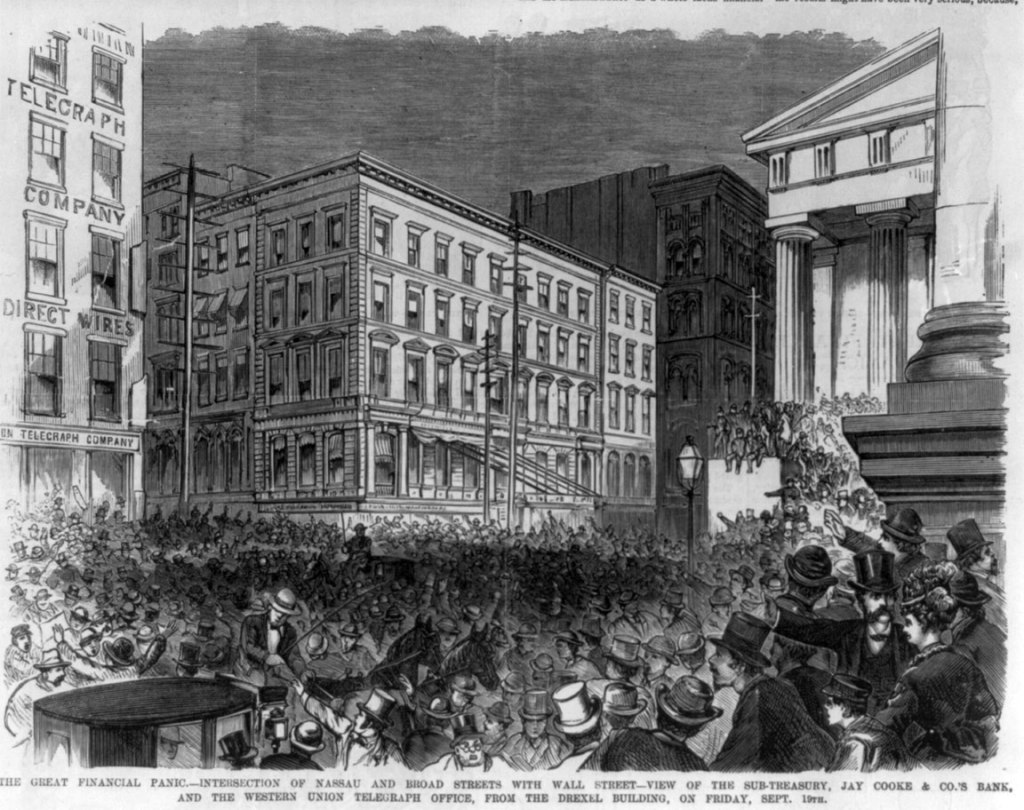
    The Panic of 1873

    Economic crises carry with them hugely devastating results: high rates of unemployment and bankruptcy are emblematic of the more modern ones. Often, a crisis is not precipitated by a flaw in the overall economy but instead a dangerous practice in a sector of that economy. Perhaps that sector has companies or individuals who have undertaken a course of action that threatens the market, and perhaps no authority figure—governmental or otherwise—can curb or stop that dangerous behavior and prevent the damage from being done. By 1873, the American railroad industry had become an industry asking for a crisis: throughout the country—and increasingly in Europe—the American railroad companies had been a popular investment; the lure of high returns was too strong for investors to resist, and the tinderbox for the impending blaze would be the bonds of railroad companies. Those bonds were the sought after investment of the time and had been collateralized—just as a piece of real estate is collateralized for a mortgage—several times over (therefore inflating the value of the bonds, the volume of the railroad bond market, and the risk of the investments). Investors, through their greed, were guaranteeing that when the market did face a disruption—and it inevitably would—that disruption, that spark, would be the beginning of a years-long economic depression.

    (more…)
  • The Legalities of Slavery

    franklin_and_armfield_slave_prison_alexandria_virginia_1836
    A Depiction of Franklin & Armfield’s Slave Prison in Alexandria, Virginia in 1836.

    By the 1830s and 1840s, slavery had become engrained in the American legal system, enjoying protections and safeguards against its abolition and ultimately ensuring its continuation.

    (more…)

  • The Second Great Awakening

    1839-meth
    A Methodist Gathering. By: J. Maze Burbank.

    In the 1810s and 1820s, Americans were drinking as much as seven gallons of alcohol per year per person, drinking at every meal. Daniel Walker Howe, What Hath God Wrought: Transformation of America, 1815-1848, 167. Even students at school could see their teacher inebriated while teaching, with drunkenness being commonplace throughout society. Id. This came, however, during the Second Great Awakening, a profound increase in religiosity in American society.

    (more…)

  • The Panic of 1819

    william-jones
    William Jones. Artist Unknown.

    America’s reliance on cotton as an economic staple presented an opportunity for prosperity and an accompanying risk. In late 1818, the value of cotton fell as supply outpaced demand and “London banks decided there was no longer a need to extend more credit.” Daniel Walker Howe, What Hath God Wrought: Transformation of America, 1815-1848, 142. Then, the Second Bank of the United States, just two years into its life, “responded by shifting suddenly away from its own expansionist policy,” by the direction of William Jones, which only exacerbated the credit problem. See id. at 142-43. The Panic of 1819 erupted.

    (more…)