Tag: Constitution

  • The Fort Hill Address

    Personalities AE  6
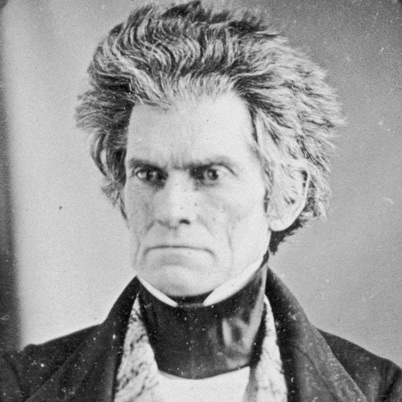
    John Calhoun.

    John Calhoun, by 1831, had alienated himself from President Andrew Jackson, and he wanted to “head off talk of secession,” and on July 26, 1831, he published his “Fort Hill Address” in a South Carolina newspaper. Daniel Walker Howe, What Hath God Wrought: Transformation of America, 1815-1848, 399.
    (more…)

  • The Most Important Veto

    old_hickory_and_bully_nick
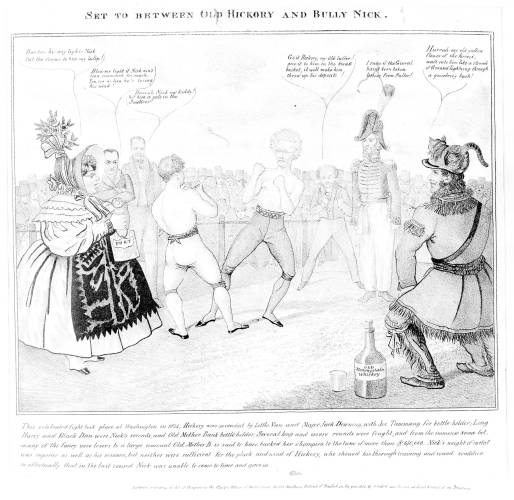
    Political Cartoon of Andrew Jackson and Nicholas Biddle. Published in Harpers Weekly in 1834.

    President Andrew Jackson did not want banknotes in the American economy, as he was an adherent to the gold standard. Daniel Walker Howe, What Hath God Wrought: Transformation of America, 1815-1848, 376. He would be forced to confront Nicholas Biddle, the President of the Second Bank of the United States.

    (more…)

  • Constitution Sunday: Letter from James Madison to Thomas Jefferson

    Letter from James Madison to Thomas Jefferson

    New York, October 24, 1787

    Following are excerpts from James Madison’s letter to Thomas Jefferson, dated October 24, 1787:

    “It remains then to be enquired whether a majority having any common interest, or feeling any common passion, will find sufficient motives to restrain them from oppressing the minority. (more…)

  • Constitution Sunday: “A Political Dialogue”

    “A Political Dialogue”

    Massachusetts Centinel (Boston), October 24, 1787

    Following are excerpts from an article published in the Massachusetts Centinel, which purported to capture a conversation between “Mr. Grumble” and “Mr. Union”:

    “Mr. Union. Well, but neighbour, what are your objections to the new Constitution?”

    “Mr. Grumble. Why, as to the matter, I can’t say I have any, but then what vexes (more…)

  • Constitution Sunday: The Weaknesses of Brutus Exposed: “A Citizen of Philadelphia” [Pelatiah Webster]

    The Weaknesses of Brutus Exposed: “A Citizen of Philadelphia” [Pelatiah Webster]

    Philadelphia, November 8, 1787

    Following is a series of excerpts from Pelatiah Webster’s article published in Philadelphia:

    “This government must have a supreme power, superior to and able to controul each and all of its parts. ‘Tis essential to all governments, that such a power (more…)

  • Constitution Sunday: “A Citizen of America” [Noah Webster]

    “A Citizen of America” [Noah Webster]

    Philadelphia, October 17, 1787

    Following are excerpts from Noah Webster’s writing:

    “Another idea that naturally presents itself to our minds, on a slight consideration of the subject, is, that in a perfect government, all the members of a society should be (more…)

  • Constitution Sunday: “An Old Whig” [George Bryan et al.] I

    “An Old Whig” [George Bryan et al.] I

    Independent Gazetteer (Philadelphia), October 12, 1787

    Following is a series of excerpts from George Bryan’s article in the Independent Gazetteer:

    “And after the constitution is once ratified, it must remain fixed until two thirds of both the houses of Congress shall deem it necessary to propose amendments; (more…)

  • The Transportation Revolution

    BF9078F5-155D-451F-6702CDB371CB71CD
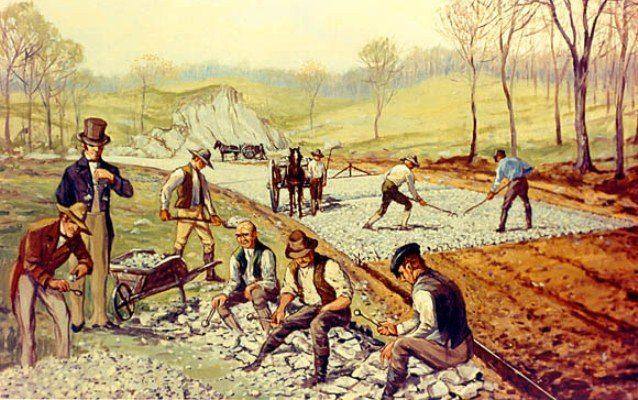
    Depiction of the Building of the National Road.

    Following the end of the War of 1812, the United States underwent a transportation revolution. This transportation revolution came about as a result of Americans moving westward but also as more Americans moved into cities to engage in industrial work. Daniel Walker Howe, What Hath God Wrought: Transformation of America, 1815-1848, 212. (more…)

  • Injury to the Cause of Christ

    lyman_beecher_-_brady-handy
    Lyman Beecher. By: Mathew Brady.

    The role of religion in Americans’ lives began to change not long after the War of 1812. In fact, the state of Connecticut “disestablished religion in 1818.” Daniel Walker Howe, What Hath God Wrought: Transformation of America, 1815-1848, 165. It should be noted that the First Amendment to the Constitution reads: “Congress shall make no law respecting an establishment of religion or prohibiting the free exercise thereof.” In other words, the First Amendment “restricted the federal government only, not the states.” Id. This would change in the 20th Century when the Supreme Court “incorporated” the freedoms of the Bill of Rights, through the Fourteenth Amendment (not passed until 1868), to the states. Id.

    (more…)

  • Constitution Sunday: Rebuttal to “An Officer of the Late Continental Army”: “Plain Truth”

    Rebuttal to “An Officer of the Late Continental Army”: “Plain Truth”

    Independent Gazetteer (Philadelphia), November 10, 1787

    Following are excerpts from an article with an unknown author, published as a rebuttal to a reply by an officer of the late Continental Army to James Wilson’s speech:

    “Congress may ‘provide for calling forth the militia,’ ‘and may provide for organizing, arming and disciplining it.’—But the states respectively can only raise it, (more…)