
After the American Revolution and after the war with Britain, America was suffering what appeared to be a crisis.
After the American Revolution and after the war with Britain, America was suffering what appeared to be a crisis.
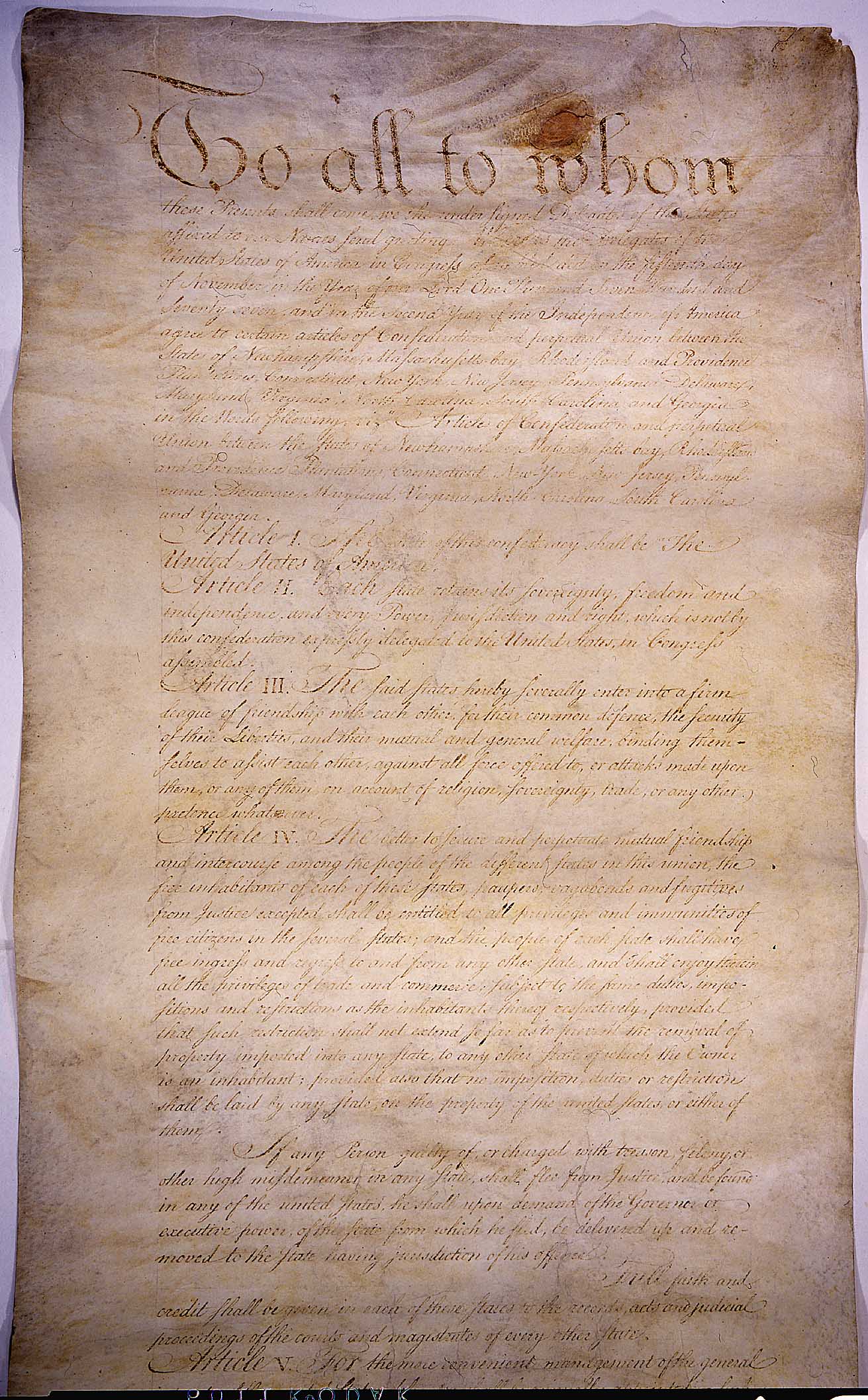
Despite the fact that the Articles of Confederation loosely held the states together, there was still a remarkable union achieved. There were privileges and immunities granted, “reciprocity of extradition and judicial proceedings among the states,” no “travel and discriminatory trade restrictions between states, and the substantial grant of powers to the Congress in Article 9 made the league of states as cohesive and strong as any similar sort of republican confederation in history—stronger in fact than some Americans had expected.” Gordon Wood, The Creation of the American Republic: 1776-1787, 359. (more…)

Americans had a keen understanding of the idea, popularized by Montesquieu, that “only a small homogeneous society whose interests were essentially similar could properly sustain a republican government.” Gordon Wood, The Creation of the American Republic: 1776-1787, 356. This idea created a fundamental problem for America: it was not a small homogeneous society, and it was rapidly expanding.
Corruption was rife in England in the decades leading up to the American Revolution, and Americans were keenly aware of that fact. For many individuals, the English Constitution was viewed as a hollow document, as the crown had taken the power away from all other sources. See Gordon Wood, The Creation of the American Republic: 1776-1787, 34-35. Americans knew that this corruption “always begins amongst the Rich and the Great” and would spread to the common people, leaving them “enfeebled and their souls depraved.” Id. at 35 quoting Pinkney’s Wmsbg. Va. Gazette, June 15, 1775; Phila. Pa. Packet, May 29, 1775, Aug. 8, 1774; Purdie and Dixon’s Wmsbg. Va. Gazette, Sept. 5, 1771. (more…)

By the time of the Revolution, the states had begun to take steps toward sustaining themselves after independence from Britain was effectuated. One of those steps was the drafting of constitutions. Constitutions, while understood generally in Britain and elsewhere, had a unique meaning for Americans.

By 1776, the states were debating their respective constitutions and the Declaration of Independence was becoming a reality, all of which was fostering an environment of great debate. One part of that debate was what the role of governor should be for each state, and many of the conclusions and decisions made during that debate carry forth to modern America.

In the earliest years of the American Republic, theories were abound about the proper structure of government to best balance equality and wise decision-making. John Adams stated, in his Thoughts on Government, that “a people cannot be long free, nor ever happy, whose government is in one assembly.” Gordon Wood, The Creation of the American Republic: 1776-1787, 208-09 quoting John Adams, Thoughts on Government, Adams, ed., Works of John Adams, IV, 194, 196. These theories became tested throughout the young country, in each of the state’s constitutions.

At the time of the American Revolution, it was commonly believed amongst Americans that formulating the ideal government would require a different system than any previously conceived. The Founding Fathers had their own ideas.

In the months leading up to the Declaration of Independence, the states began the process of adopting their own constitutions. These constitutions, being drafted in 1776, approximately 13 years before the United States Constitution would be ratified, had to confront many of the same issues as the United States Constitution, with various approaches being taken. (more…)

For many of the Founding Fathers, the biggest threat to the stability and success of the United States was tyranny. Tyranny was a force that could bring down the most free and just societies. Underlying much of the creation of the institutions that now define the American government, the judiciary, the legislature, and the executive, are precautionary and prophylactic measures to prevent tyranny. (more…)
 Last Best Hope of Earth