Tag: Constitution

  • Constitution Sunday: “Americanus” V

    “Americanus” V [John Stevens, Jr.]

    Daily Advertiser (New York, December 12, 1787

    The structure of the American government, with its division into three branches and its layered arrangement from top (federal) to middle (state) to bottom (local), made it an exception in 1787 from what had been previously known. Even with the Constitution’s framework appearing to better safeguard against the country devolving into a dictatorship or monarchy, there remained the plausible theory that, despite the Constitution’s best features, it would do nothing more than slow, or mitigate, that devolution; it would be unable to prevent it. (more…)
  • Constitution Sunday: “Publius,” The Federalist XVI

    “Publius,” The Federalist XVI [Alexander Hamilton]

    New-York Packet, December 4, 1787

    When any union or confederacy of states or provinces decide to form a nation, it does so with its citizens knowing that members may “alarm the apprehensions, inflame the passions, and conciliate the good will even” in those states that were not “chargeable with any violation, or omission of duty” but had influence to be obtained. As Alexander Hamilton wrote in the Federalist XVI, when there are associates not found “at home, recourse would be had to the aid of foreign powers, who would seldom be disinclined to encouraging the dissentions of a confederacy, from the firm Union of which they had so much to fear.” The consequences of such an event are substantial: “When the sword is once drawn, the passions of men observe no bounds of moderation. The suggestions of wounded pride, the instigations of irritated resentment, would be apt to carry the States, against which the arms of the Union were exerted to any extremes necessary to revenge the affront, or to avoid the disgrace of submission. The first war of this kind would probably terminate in a dissolution of the Union.” (more…)

  • Constitution Sunday: “Publius,” The Federalist XIV

    “Publius,” The Federalist XIV [James Madison]

    New-York Packet, November 30, 1787

    With the draft Constitution having been published for consideration by the residents of each state in 1787 came questions about whether and how the federal government would effectuate its responsibilities given the vast land that the states and territories had already comprised—which James Madison found to be framed by the Atlantic Ocean and the Mississippi River. Madison, in The Federalist XIV, articulated the reasoning behind the Constitution’s model for government, and at the heart of that reasoning was that this new form of government was not going to be a pure democracy of yore but rather a modern republic: “The true distinction” between a democracy and a republic is “that in a democracy, the people meet and exercise the government in person; in a republic they assemble and administer it by their representatives and agents. A democracy consequently will be confined to a small spot. A republic may be extended over a large region.” (more…)

  • Constitution Sunday: “Brutus” IV

    “Brutus” IV

    New York Journal, November 29, 1787

    At the heart of a healthy democracy is the power for people or their representatives to create, modify, or repeal the laws for those laws inevitably govern nearly all aspects of life. The New York Journal published an article that dissected fair representation in the proposed Constitution:

    “The object of every free government is the public good, and all lesser interests yield to it. That of every tyrannical government, is the happiness and aggrandisement of one, or a few, and to this the public felicity, and every other interest must submit. (more…)

  • Constitution Sunday: “The Republican” to the People

    “The Republican” to the People

    Connecticut Courant (Hartford), January 7, 1788

    The liberties that Americans hold dear are not inherently self-sustaining. While the Constitution secures many liberties, it requires Americans to be vigilant in fulfilling their civic duties. This week’s Constitution Sunday highlights the Connecticut Courant, which explored these issues amidst the debate about ratifying the Constitution: (more…)

  • Constitution Sunday: “Cato” V

    “Cato” V

    New York Journal, November 22, 1787

    Following are excerpts from an anonymous article published in the New York Journal:

    To the Citizens of the State of New-York.

    In my last number I endeavored to prove that the language of the article relative to the establishment of the executive of this new government was vague and inexplicit, that the great powers of the President (more…)

  • The North’s Attempt at Salvation

    washington-dc
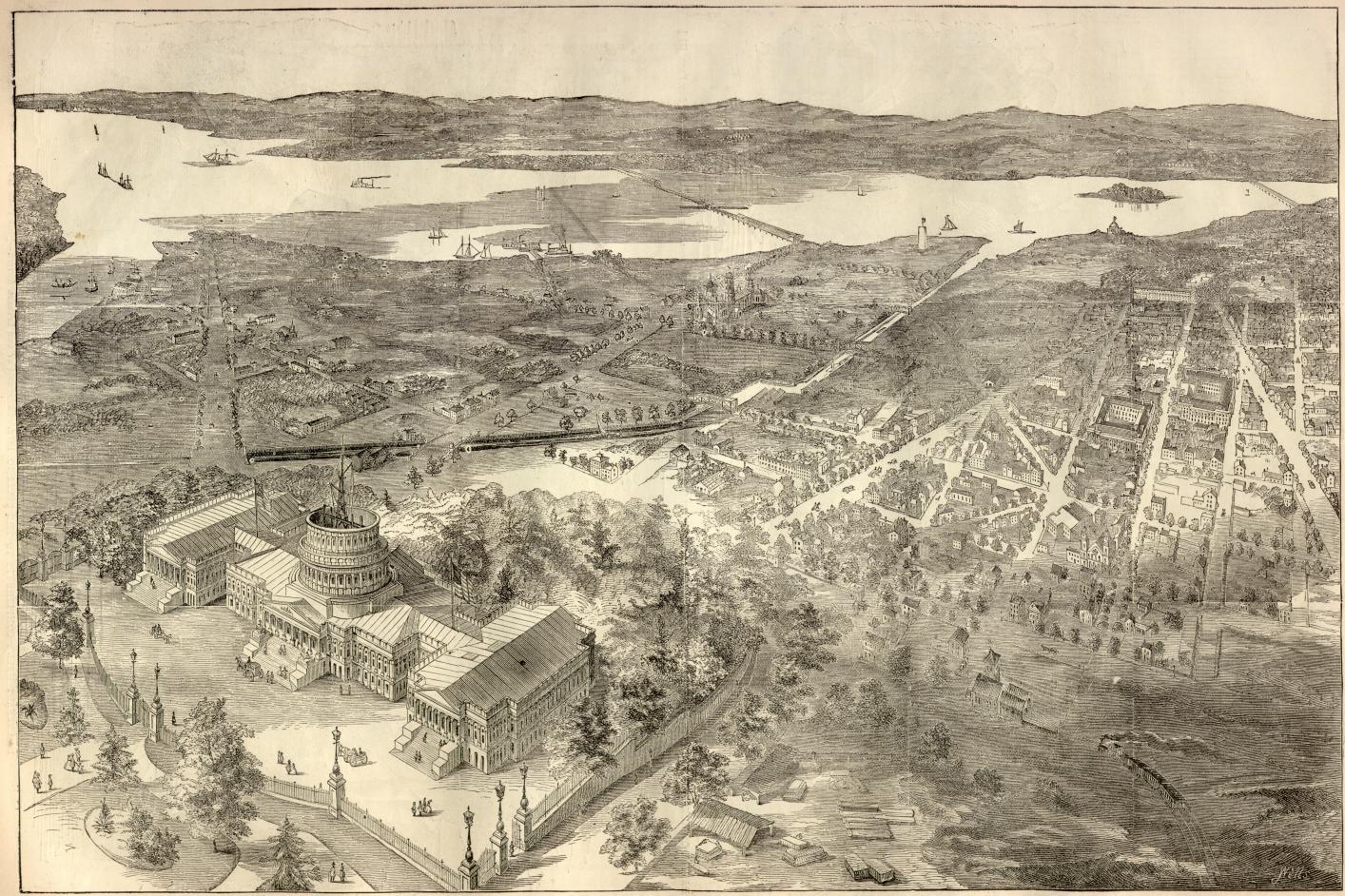
    Aerial Perspective of Washington DC in 1861.

    The Deep South’s animating of a Second American Revolution, by seceding from the Union and laying the foundation for an operational Confederate government, forced the North to either suppress the South’s uprising or craft a resolution. The likelihood of war would deter any widespread northern suppression, leaving the question: What compromise could the North propose that appeased the South and put both sections of the country on a path of coexistence? While variations of this question had been posed in the years leading up to 1860, at no prior point were states seceding from the Union en masse to form a rival government. (more…)

  • Constitution Sunday: Answers to Mason’s “Objections”: “Marcus” [James Iredell] IV

    Answers to Mason’s “Objections”: “Marcus” [James Iredell] IV

    Norfolk and Portsmouth Journal (Virginia), March 12, 1788

    Following are excerpts from James Iredell’s responses to George Mason’s “Objections” to the Constitution:

    VIIIth. Objection. ‘Under their own construction of the general clause at the end of the enumerated powers, the Congress may grant monopolies in trade and commerce, constitute new crimes, inflict unusual and severe punishments, and extend their power as far as they shall think proper (more…)

  • The Precursor to the Winter of Secession

    168095
    Washington in 1860. Photographer Unknown.

    Abraham Lincoln’s victory in the Election of 1860 was disconcerting news for the South. It was the most recent event in a string of events that seemingly endangered the southern way of life and the future of the country. At a time when many northerners suspected southern threats of secession were but a bluff, there was evidence that the country had already split and the formalities were soon to follow. (more…)

  • Constitution Sunday: Answers to Mason’s “Objections”: “Marcus” [James Iredell] II

    Answers to Mason’s “Objections”: “Marcus” [James Iredell] II

    Norfolk and Portsmouth Journal (Virginia), February 27, 1788

    Following are excerpts from James Iredell’s responses to George Mason’s “Objections” to the Constitution:

    IVth. Objection. The Judiciary of the United States is so constructed and extended, as to absorb and destroy the Judiciaries of the several States (more…)