Tag: Constitution

  • The Lincoln-Douglas Debates of 1858

    l_lincoln-douglas_1200x675
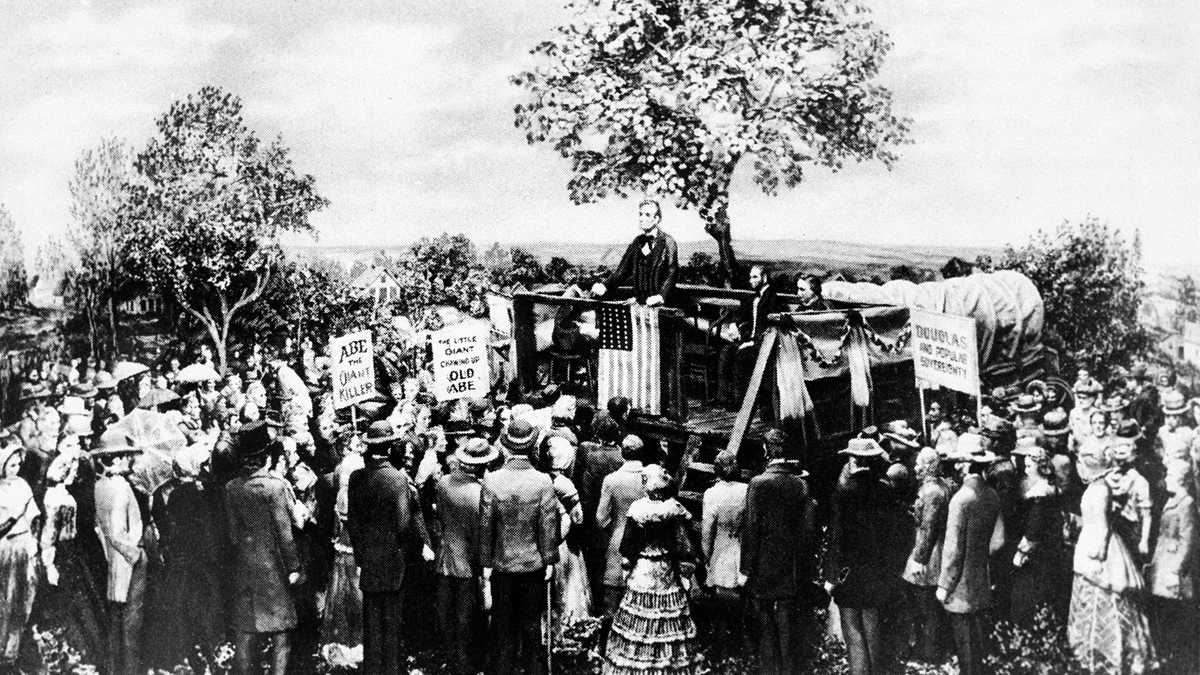
    Depiction of the Lincoln-Douglas Debates.

    Senator Stephen Douglas had come into the political spotlight through his work in the Compromise of 1850 and the Kansas-Nebraska Act, which had temporarily held the country together but perpetuated the institution of slavery. Douglas, a Democrat, was a force to be reckoned with for keeping a seat in the United States Senate despite the growing strength of the Republican Party throughout the North and in his home state of Illinois. Throughout 1858, a time when the state legislatures elected senators to the United States Senate, Douglas would have to win the support of the people of Illinois, and the Illinois legislature, by debating the issue of slavery, and the future of the country, with the Republican candidate for the Senate, Abraham Lincoln. See David Potter, The Impending Crisis: America Before the Civil War, 1848-1861, 330-31. (more…)

  • A Supreme Court Tragedy: Dred Scott v. Sandford

    05_e
    The Taney Supreme Court.

    In 1857, the United States Supreme Court decided one of the most controversial cases in the history of the country. Just days after James Buchanan began his term as president, Chief Justice Roger Taney wrote the opinion for the Court, ruling that neither slaves nor freedmen could be citizens of the United States. The implications of this decision, and its reasoning, have been analyzed, dissected, and discussed since 1857. While many have concluded it is one of the Supreme Court’s worst decisions, its impact on Antebellum America should not be overlooked.

    (more…)

  • The Role of Slavery in Splitting America

    underground_railroad
    The Underground Railroad. By: Charles T. Webber.

    Since the outbreak of the Civil War and continuing to the present day, the role of slavery in splitting America has been hotly debated. One may wonder whether there was merely a correlation between slavery and the Civil War or whether slavery was the cause. Investigating the nuances of the issue of slavery reveals that the Civil War resulted from sectionalism and slavery, which were practically synonymous.

    (more…)

  • Constitution Sunday: Reply to Mason’s “Objections”: “Civis Rusticus”

    Reply to Mason’s “Objections”: “Civis Rusticus”

    Virginia Independent Chronicle (Richmond), January 30, 1788

    Following are excerpts of an article written in response to George Mason’s article listing the objections to the Constitution:

    “5th. Had the convention left the executive power indivisible, I am free to own it would have been better, than giving the senate a share in it (more…)

  • Constitution Sunday: George Mason, “Objections to the Constitution”

    George Mason, “Objections to the Constitution”

    Circulated early October 1787, published in full in the Virginia Journal (Alexandria), November 22, 1787

    Following are excerpts from George Mason’s article, articulating objections to the Constitution, as submitted to the states for ratification:

    “Gentlemen, At this important crisis when we are about to determine upon a government which is not to effect us for a month, for a year, or for our lives: but which, it is probable, will extend (more…)

  • Constitution Sunday: “Publius,” The Federalist IX [Alexander Hamilton]

    “Publius,” The Federalist IX [Alexander Hamilton]

    Independent Journal (New York), November 21, 1787

    Following are excerpts from Alexander Hamilton’s writings in the Federalist Papers:

    “When Montesquieu recommends a small extent for republics, the standards he had in view were of dimensions, far short of the limits of almost every one of these States. (more…)

  • Constitution Sunday: “Publius,” The Federalist VIII [Alexander Hamilton]

    “Publius,” The Federalist VIII [Alexander Hamilton]

    New-York Packet, November 20, 1787

    Following are excerpts from The Federalist VIII, authored by Alexander Hamilton:

    “Assuming it therefore as an established truth that the several States, in case of disunion, or such combinations of them as might happen to be formed out of the wreck of the general confederacy, (more…)

  • Constitution Sunday: “A Landholder” [Oliver Ellsworth] III

    “A Landholder” [Oliver Ellsworth] III

    Connecticut Courant (Hartford), November 19, 1787

    Following are excerpts from Oliver Ellsworth’s article in the Connecticut Courant:

    “A government capable of controling the whole, and bringing its force to a point is one of the prerequisites for national liberty. (more…)

  • Constitution Sunday: “Philanthrop” to the Public

    “Philanthrop” to the Public

    American Mercury (Hartford), November 19, 1787

    Following are excerpts from an article in the American Mercury, located in Hartford, Connecticut:

    “Let us for a moment call to view the most specious reason that can be urged by the advocates for anarchy and confusion, and the opposers to this glorious Constitution, and see what weight a rational man could give (more…)

  • Constitution Sunday: George Washington to Bushrod Washington

    George Washington to Bushrod Washington

    Mount Vernon, November 10, 1787

    Following are excerpts from George Washington’s letter to Bushrod Washington:

    “Dear Bushrod: In due course of Post, your letters of the 19th. and 26th. Ult. came to hand and I thank you for the communications therein; for a continuation in matters of importance, I shall be obliged to you. (more…)