Tag: Maryland

  • The Transportation Revolution

    BF9078F5-155D-451F-6702CDB371CB71CD
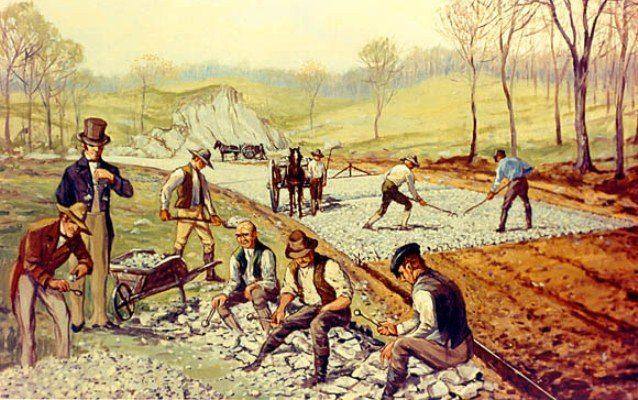
    Depiction of the Building of the National Road.

    Following the end of the War of 1812, the United States underwent a transportation revolution. This transportation revolution came about as a result of Americans moving westward but also as more Americans moved into cities to engage in industrial work. Daniel Walker Howe, What Hath God Wrought: Transformation of America, 1815-1848, 212. (more…)

  • The Genesis of the Bill of Rights

    magna_carta_british_library_cotton_ms_augustus_ii-106
    Magna Carta.

    Prior to the American Revolution, the colonists had become familiar with the concept of charters. Charters, whether royal, corporate, or proprietary, operated “as the evidence of a compact between an English King and the American subjects.” Gordon Wood, The Creation of the American Republic: 1776-1787, 268; see also Leonard Krieger, The Politics of Discretion: Pufendorf and the Acceptance of Natural Law (Chicago, 1965), 121.

    (more…)

  • A Check on Dangerous Usurpations

    1545_1115
    Samuel Chase. By: John Beale Bordley.

    While an upper house of state legislatures was desirable to some, as explained in The Birth of the Senate, it also had its detractors. Those detractors argued that it was a mere redundancy, wholly irrelevant to the founding of a stable government. In taking that position, the detractors ignored many of the benefits of having a second house in the legislature.

    (more…)

  • Unalterable Constitutions

    independence_hall_in_philadelphia_by_ferdinand_richardt_1858-63
    Independence Hall in Philadelphia, Pennsylvania. By: Ferdinand Richardt.

    As the constitutions of the states were implemented and executed during the Revolutionary years, the population began holding conventions for amendment of those constitutions, believing that “Legislatures were incompetent” to do so. Gordon Wood, The Creation of the American Republic: 1776-1787, 306 quoting Farrand, ed., Records of the Federal Convention, II, 91-93. In fact, James Madison believed that “it would be a novel and dangerous doctrine that a Legislature could change the constitution under which it held its existence.” Id.

    (more…)

  • Laboratories of Democracy

    colonial_williamsburg_governors_palace_front_dscn7232
    Governor’s Palace. Williamsburg, Virginia.

    In the months leading up to the Declaration of Independence, the states began the process of adopting their own constitutions. These constitutions, being drafted in 1776, approximately 13 years before the United States Constitution would be ratified, had to confront many of the same issues as the United States Constitution, with various approaches being taken. (more…)