Following the violence in Kansas known as Bleeding Kansas, there was a question of whether the territory would be admitted as a free state or slave state. After taking office in 1857, President James Buchanan appointed Robert J. Walker of Pennsylvania to be governor of Kansas. Governor Walker wrote a letter to President Buchanan, stating “that the actual bona fide residents of the territory of Kansas, by a fair and regular vote, unaffected by fraud or violence, must be permitted, in adopting their State Constitution, to decide for themselves what shall be their social institutions.” Walker to Buchanan, March 26, 1857, in Kansas State Historical Society Transactions, V (1891-1896), 290 (italics in original). Even with such a pronouncement regarding the nature of an election, no one knew how Kansans would vote on the issue of slavery or how soon Kansas would become a state. (more…)
In 1844, Asa Whitney, a merchant in New York, proposed that a transcontinental railroad be built. While he hoped to lead the construction of the railroad and reap the benefits of the ambitious project, that was not to be. However, three components of his plan captured the spirit of Americans toward the construction of the railroad: “There must be a railroad to the Pacific; it must be financed by grants of public lands along the route; and it must be built by private interests which received these grants.” David Potter, The Impending Crisis: America Before the Civil War, 1848-1861, 146. (more…)
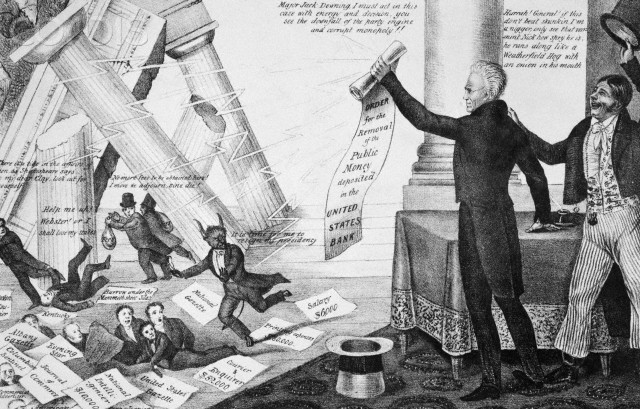
Political Cartoon Depicting the Maysville Road Veto.
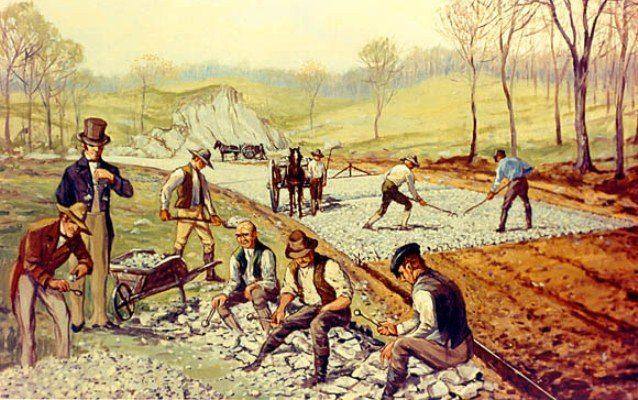
The Maysville Road was a major internal improvement that Congress had captured in a bill, the Maysville Road Bill. Daniel Walker Howe, What Hath God Wrought: Transformation of America, 1815-1848, 357. It was meant to be a link in the burgeoning transportation network, “connecting the National Road to the north with the Natchez Trace to the south and the Ohio with the Tennessee river systems.” Id.
Certificate for Life Membership in the American Colonization Society.
The American Colonization Society, the premier organization advocating for the exportation of slavery to Africa, had a major supporter in Secretary of State Henry Clay in the late 1820s.
Following the end of the War of 1812, the United States underwent a transportation revolution. This transportation revolution came about as a result of Americans moving westward but also as more Americans moved into cities to engage in industrial work. Daniel Walker Howe, What Hath God Wrought: Transformation of America, 1815-1848, 212. (more…)
Not long after the election of 1820, an essentially uncontested election seeing the re-election of President James Monroe, the campaigning for the election of 1824 began. President Monroe had indicated that he would not seek an unprecedented third term as president, but that did not stop others from posturing for the election. As a journalist observed in the spring of 1822, “electioneering begins to wax hot.” Daniel Walker Howe, What Hath God Wrought: Transformation of America, 1815-1848, 203 quoting James F. Hopkins, “Election of 1824,” in History of American Presidential Elections, ed. Arthur M. Schlesinger Jr. (New York, 1985), 363.
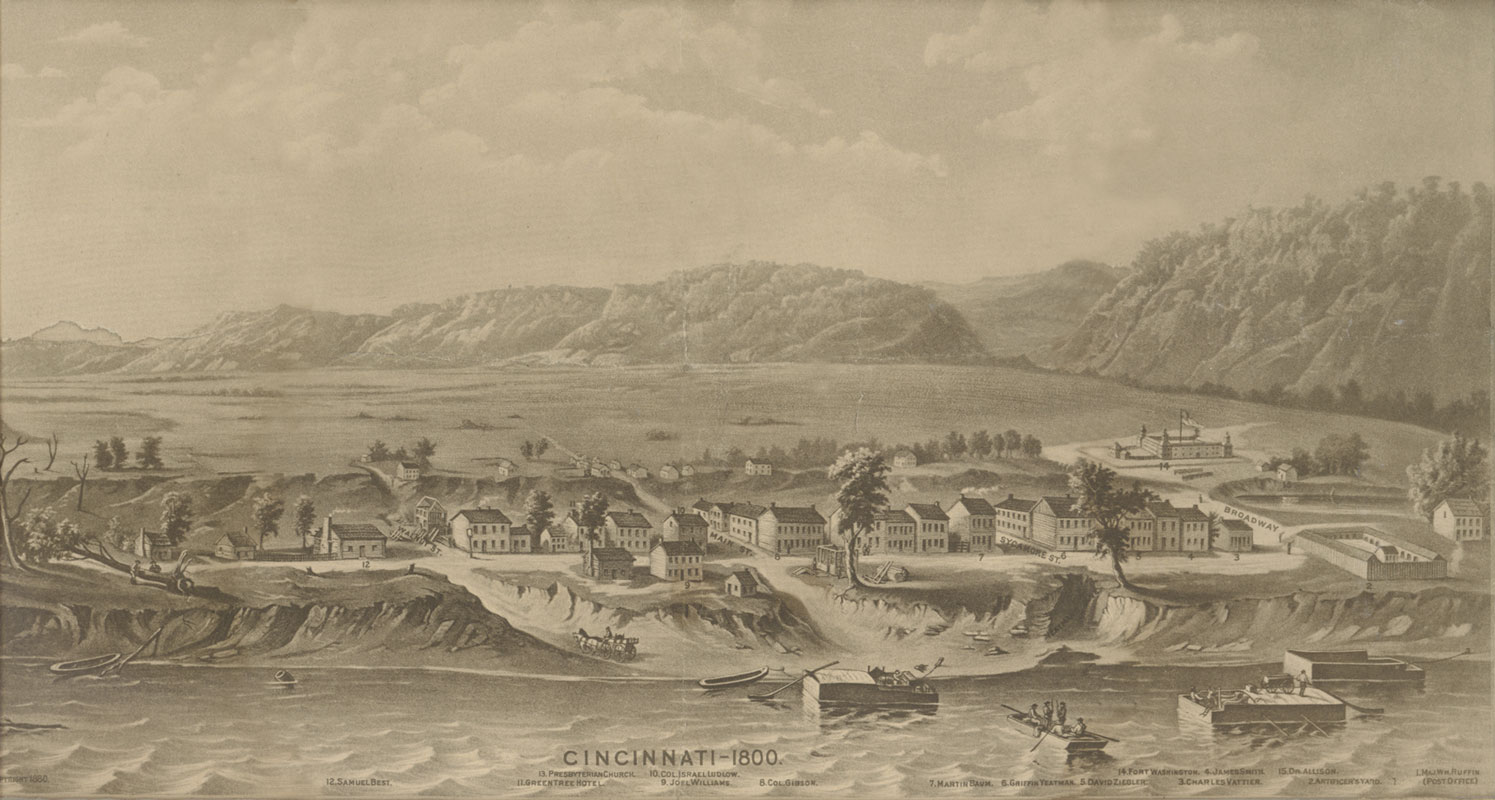
Lithographic Print of Cincinnati, Ohio. 1800. By: Stobridge Lithographing Co.
Ohio was admitted into the Union in 1803, and it introduced a new political system to the United States. Each county in Ohio had county commissions that each county’s citizens elected, rather than the states of the South and Southwest, who had self-perpetuating commissions. Gordon Wood, Empire of Liberty, 365.
Further, each county commission had overlapping jurisdiction with “towns, school districts, and other subdivisions,” which produced a variety of offices for election. Id. Local citizens were responsible for electing its local representatives to these towns, school districts, and county commissions, as well as fulfilling their obligations for electing representatives to the Ohio State Senate and House of Representatives and of course the federal Senate and House of Representatives.
Gordon Wood notes in Empire of Liberty that so many political offices open created a widespread, competitive political atmosphere, with dozens and dozens of candidates running for the various offices then open for politicians in Ohio. For example, 116 men ran for “Hamilton County’s [the County including Cincinnati] seven seats in Ohio’s third territorial assembly.” Id. In 1803, 22 candidates ran to be Ohio’s first governor. Id.
Meanwhile, because of Ohio’s diverse economy, “with a variety of markets and no simple distribution for the region’s many products,” small towns began popping up all over Ohio. Id.
These early years in Ohio inevitably created a sense of participation in politics on all levels for Ohioans. As is familiar for modern Americans, early Ohioans, beginning in 1803, would participate in their local politics, state politics, and federal politics. Unlike other states in the Union in the South and Southwest of the country then, Ohioans would have an active role in electing their local governments and having a say in how local affairs were conducted.
The fact that so many Americans had no ability to be involved in their local elections prior to this Ohioan system being adopted deserves more analysis. The uniquely American obsession with having democratic principles from top to bottom and from small to large has spread throughout the United States by now, but in those early years, it is clear that the extent of democratic rights were, for some, perhaps just limited to state elections and federal elections.
Americans now enjoy the full benefits of democracy on the local level, the state level, and the federal level. Some in the early years of the Republic may have questioned the capability of the citizenry to be informed enough to elect their local politicians. But there is no question that the election of local politicians, whether they be in school districts, county commissions, or towns, is a fundamental responsibility that is valued by Americans who choose to inform themselves and exercise their right to vote.



 Last Best Hope of Earth