Tag: Thomas Jefferson

  • The Civil War: New-York Daily Tribune: The Right of Secession

    December 17, 1860

    Thurlow Weed, the editor of the Albany Evening Journal and one of the leaders of the Republican Party in New York, had criticized another newspaper editor, Horace Greeley of the New-York Daily Tribune. Weed’s criticism was on the issue of secession and Greeley’s apparent support for it.

    (more…)
  • The Revolution: Thomas Jefferson on the Draft Articles of Confederation (Part I)

    The Autobiography. By: Thomas Jefferson.

    July 30, 1776 – July 31, 1776

    In Thomas Jefferson’s autobiography, he wrote of the debate and adoption of the Articles of Confederation. While the country has long learned that the Constitution is far superior to those Articles, the reasons why must extend beyond “a stronger national government was needed under the Articles, and the Constitution cured that defect.” A committee took up the Articles on July 30th and 31st and then August 1st of 1776. During the first couple days, the delegates debated how to calculate each state’s monetary contribution to the “common treasury” and the “manner of voting in Congress.” And it was there that controversy occurred; controversy that would continue to the time when the Constitution was drafted and adopted and even to nearly 250 years later.

    (more…)
  • The Theories of Slavery

    a89cbad2a1dccb130f3199e02ae7de2c
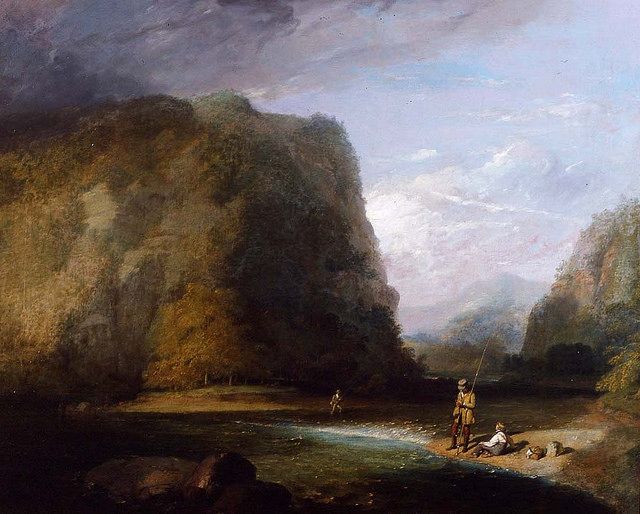
    Trout Fishing in Sullivan County, New York. By: Henry Inman.

    In the 15 years leading up to the Civil War, a wide variety of theories emerged for how the federal government should deal with slavery expanding, or not expanding, into the territories acquired by the United States.

    (more…)

  • The Role of Slavery in Splitting America

    underground_railroad
    The Underground Railroad. By: Charles T. Webber.

    Since the outbreak of the Civil War and continuing to the present day, the role of slavery in splitting America has been hotly debated. One may wonder whether there was merely a correlation between slavery and the Civil War or whether slavery was the cause. Investigating the nuances of the issue of slavery reveals that the Civil War resulted from sectionalism and slavery, which were practically synonymous.

    (more…)

  • Manifest Destiny

    demrevcontentspage
    The Democratic Review Magazine.

    While many Americans would come to embrace manifest destiny, the idea that America would achieve its imperial destiny and dominate the continent, it was not a politician or president who coined the term. Rather, it was coined in 1845 in New York’s Democratic Review magazine. See Daniel Walker Howe, What Hath God Wrought: Transformation of America, 1815-1848, 702-03.

    (more…)

  • The Inauguration of William Henry Harrison

    rembrandt_peale_-_william_henry_harrison_-_google_art_project
    William Henry Harrison. By: Rembrandt Peale.

    William Henry Harrison, a Whig, won the White House in the election of 1840. In March 1841, for his inauguration, he stood in the cold and wind and spoke for an hour and a half. See Daniel Walker Howe, What Hath God Wrought: Transformation of America, 1815-1848, 570.

    (more…)

  • The Decline of the Militia

    1828_militiamuster_watercolor_bydcjohnston_aas
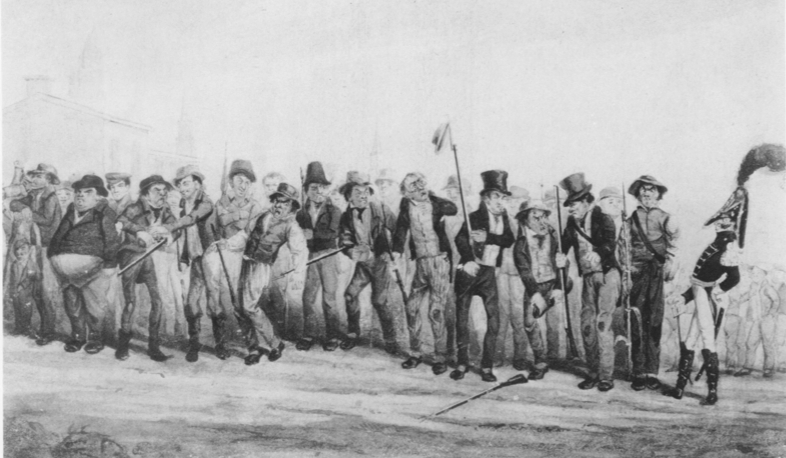
    Depiction of a Militia in 1828.

    From the War of 1812 on, for the next few decades, the use of militias would become less and less prominent in America.

    (more…)

  • A First Test for Separation of Church and State

    cholera-1832
    A Depiction of the Cholera Outbreak in New York City in 1832.

    With the communications and transportation revolution came new, unforeseeable consequences. One such consequence was the spread of cholera and other contagious diseases, which would test the mettle of Americans.

    (more…)

  • Constitution Sunday: Jefferson Replies to Madison

    011914efc09968f8736c1d523526ff1a Read today’s Constitution Sunday in Russian.

    Thomas Jefferson Replies to Madison

    Paris, December 20, 1787

    Following are excerpts from Thomas Jefferson’s letter to James Madison:

    “I like the power given the Legislature to levy taxes, and for that reason solely approve of the greater house being chosen by the people (more…)

  • The Fort Hill Address

    Personalities AE  6
    John Calhoun.

    John Calhoun, by 1831, had alienated himself from President Andrew Jackson, and he wanted to “head off talk of secession,” and on July 26, 1831, he published his “Fort Hill Address” in a South Carolina newspaper. Daniel Walker Howe, What Hath God Wrought: Transformation of America, 1815-1848, 399.

    (more…)